.svg)

Find Race Fuel Near You: Complete Guide to Locating and Selecting the Right Fuel
105 octane gas is a purpose-built race fuel that fills the performance gap between 100 octane street/strip fuels and dedicated 110 octane race fuels. It provides the knock resistance that engines with moderately high compression, moderate boost, or sustained high-load demands have outgrown 100 octane to need, without requiring the additional octane that extreme competition builds demand.
For many builds, the decision between 100 and 110 octane misses a middle ground where the engine genuinely fits neither tier. The Sunoco Fuel Selector confirms which octane level matches a specific engine, but understanding what 105 octane is and when it applies helps racers arrive at that decision with context rather than guesswork.
What Is 105 Octane Gas?
105 octane gas is a race fuel rated at 105 (R+M)/2, meaning the average of its Research Octane Number and Motor Octane Number equals 105. It is not simply stronger gasoline. Like every other race fuel, its octane rating measures resistance to knock and detonation under pressure and heat, not energy content, combustion speed, or horsepower potential. As fueleconomy.gov explains, higher octane fuels are required for engines that use higher compression ratios or forced induction to extract more power, because those conditions require greater knock resistance to prevent premature combustion.
The (R+M)/2 rating system is the standard used across the United States for consumer and racing fuel labeling. Research Octane Number measures knock resistance at low engine speeds and loads; Motor Octane Number measures it at higher speeds and loads closer to racing conditions. The average of the two provides a single number that accounts for both operating environments. ASTM International's fuel testing standards govern how both measurements are conducted and how fuels are classified.
Sunoco Surge is Sunoco's 105 octane race fuel. It carries a Research Octane Number of 109 and a Motor Octane Number of 101, producing the 105 (R+M)/2 rating. It is leaded, contains no ethanol, is blended from highly refined hydrocarbons, and is dyed light yellow to prevent confusion when mixing two-stroke oil into the fuel. Its lead content was engineered to match amounts found in vintage gasolines from the 1960s, which makes it particularly well-suited to classic and vintage engines built around leaded fuel chemistry. Shelf life is three years under proper storage conditions.

Where 105 Octane Fits in the Race Fuel Lineup
Race fuel selection is not a linear progression where higher always means better. Each octane tier is designed for a different range of engine combinations, and the correct fuel is the one whose knock resistance matches what the engine actually requires.
|
Fuel |
Octane |
Typical Compression |
Typical Applications |
|
Pump premium |
91 to 93 |
Up to 9.5:1 |
Stock and mildly modified street engines |
|
100 |
10.5 to 11.5:1 |
Street/strip, track days, mild forced induction |
|
|
104 |
11.0 to 12.0:1 |
Oxygenated unleaded option; applications where lead is prohibited |
|
|
105 |
11.5 to 12.5:1 |
High-RPM powersports, moderate forced induction, drag strip, vintage |
|
|
110 |
Up to 13:1 conventional; higher with aluminum heads |
Dedicated race engines, high boost, sustained competition |
|
|
116 |
Extreme builds |
High-boost competition, professional drag racing |
These compression figures are general starting points. Actual octane requirements depend on combustion chamber design, camshaft timing, ignition advance, intercooling effectiveness, ambient temperature, altitude, and engine management calibration. Two engines at the same static compression ratio can have meaningfully different octane requirements based on those variables. Engine builder and tuner recommendations are always the most reliable guide for a specific combination.
The pump premium row matters for context because it is the baseline most modified engines are leaving behind. Why race fuel becomes necessary as engines are modified explains the transition point in detail.
Which Engines Benefit from 105 Octane Gas
The engines that benefit most from 105 octane share a common characteristic: they have moved past what 100 octane reliably supports but are not running the extreme compression ratios or boost levels that require 110 octane or above.
- High-RPM powersports engines. Dirt bikes, ATVs, snowmobiles, and side-by-sides with high-compression engines are the primary applications Surge was formulated for. These engines combine elevated compression ratios with high RPM operation and carbureted fuel delivery, which makes knock resistance and fuel consistency both critical. The light yellow dye on Surge specifically accommodates two-stroke applications where oil is mixed directly into the fuel. Sunoco's powersports race fuel lineup spans the full range of applications in this category.
- Naturally aspirated engines at higher compression. An engine running 11.5:1 to 12.5:1 compression with aggressive camshaft timing and optimized ignition advance is operating in territory where 100 octane begins to limit what the tuner can safely do. More compression produces more cylinder pressure and temperature before ignition, which increases knock risk at any given timing value. The knock resistance that 105 octane provides extends the tuning window without requiring a jump to 110 octane that the engine may not need.
- Moderate forced induction. A turbocharged or supercharged engine that has outgrown 100 octane but is not running the extreme boost levels that demand 110 or higher falls squarely in Surge territory. Effective compression ratio under boost rises with every additional pound of pressure, and the detonation risk that comes with it requires a fuel that can keep pace. Each boost increase should be evaluated against the current fuel's knock resistance and the intercooler's ability to manage charge temperatures.
- Drag strip applications with large intake runners. Surge is specifically listed for drag strip use, particularly engines with large intake runners where fuel atomization and throttle response behavior at the carburetor matter alongside raw octane. The quick throttle response and cold starting behavior noted in the product specifications reflect a formulation tuned for this environment. Sunoco's drag racing fuel options span the full octane range for builds at every level of competition.
- Muscle car and vintage applications. Engines built around leaded fuel chemistry from the 1960s have a natural fit with Surge because its lead content was engineered to approximate what was in the pump at that era. High-compression big-block and small-block V8s that run uncomfortably on modern unleaded pump gas have a purpose-built option here that the other fuels in the lineup do not provide at this octane level. The leaded race fuel page covers why lead matters in racing applications and when it is the right choice for a specific build.
- When 105 octane is not enough. Engines approaching 13:1 compression or above, large nitrous systems, very high boost levels, endurance circle track racing, and professional drag racing classes typically require the additional knock resistance of Sunoco Standard at 110 octane or higher. Builds that have moved past Surge will find the options above 110 octane on Sunoco's high-octane race fuel lineup.

Frequently Asked Questions About 105 Octane Gas
What is 105 octane gas?
105 octane gas is a race fuel rated at 105 (R+M)/2, designed for engines that have outgrown 100 octane but do not require the knock resistance of 110 octane fuels. It bridges the gap between street/strip race fuels and dedicated competition race fuels, covering moderately high compression engines, moderate boost applications, high-RPM powersports engines, and vintage builds that need leaded fuel chemistry.
Is 105 octane better than 100 octane?
For engines that need it, yes. For engines that do not, it provides no additional benefit. 105 octane provides more knock resistance than 100 octane, which matters when an engine's compression ratio, boost level, ignition timing, or operating environment has moved past what 100 octane safely supports. An engine operating comfortably within the capability of 100 octane gains nothing from switching to 105.
Is 105 octane better than 110 octane?
For engines in its target range, 105 octane is the more appropriate choice. Running more octane than an engine needs provides no power benefit and adds cost. 110 octane is formulated for more extreme engine combinations with higher compression, greater boost, or sustained racing loads that exceed what 105 octane supports. Matching the fuel to the engine's actual requirement is more important than maximizing the octane number.
Will 105 octane increase horsepower?
Not by itself. Octane measures resistance to knock, not energy content. Switching from 100 to 105 octane in an engine that was not knock-limited on 100 octane will not produce a measurable power increase. Where 105 octane enables additional power is when inadequate knock resistance was previously limiting compression, timing, or boost. The additional headroom allows a tuner to optimize those parameters, and those changes produce the power gain, not the octane number. Understanding exactly when a fuel change translates to a power gain is worth reading before making any fuel decision based on horsepower expectations.
What compression ratio requires 105 octane?
Generally, engines in the 11.5:1 to 12.5:1 range are the natural fit for 105 octane, though this varies significantly based on combustion chamber efficiency, camshaft timing, ignition advance, cooling, and whether the engine is naturally aspirated or boosted. These figures are a starting point for conversation with an engine builder or tuner, not a universal rule.
Can I mix 100 and 110 octane to make 105?
Blending two fuels changes more than octane level. Specific gravity, ethanol content if present, oxygen content, vapor pressure, and combustion characteristics all shift when fuels are blended, and the result may not behave predictably in a calibration built around either fuel individually. Using a purpose-built 105 octane fuel eliminates that variability and provides a known, consistent baseline the engine can be tuned around.
Is 105 octane safe for street-driven vehicles?
Sunoco Surge is formulated for off-road and racing applications. It is leaded, which makes it incompatible with catalytic converters and oxygen sensors. It is legal only for racing vehicles in sanctioned events. For street-driven vehicles requiring additional knock resistance, an unleaded option like Sunoco 260 GT or SS 100 at 100 octane is the appropriate choice.
How long does 105 octane fuel last in storage?
Sunoco Surge has a three-year shelf life when stored properly in opaque, tightly sealed containers kept at stable temperatures. This extended shelf life reflects the stable hydrocarbon blendstock and modern additive technology used in its formulation, and makes it well-suited to vintage and seasonal applications where fuel may sit between events for extended periods. Proper storage protocols for race fuel are worth reviewing before buying in bulk for a season.
Why Higher Octane Does Not Automatically Mean More Power
This is the most important concept for any racer evaluating a fuel change. Octane rating measures resistance to knock, not energy content. A fuel rated at 105 octane does not contain more energy than one rated at 100 octane. It resists autoignition under higher cylinder pressure and temperature before detonation occurs.
If an engine is already operating safely within the limits of its current fuel, a higher octane number provides no performance benefit. The additional knock resistance goes unused. Where a higher octane fuel unlocks additional power is when the engine was previously knock-limited: the tuner could not safely reach the optimal ignition timing, compression ratio, or boost level because the previous fuel began detonating before those settings were achievable. The new fuel's additional headroom allows the calibration to be optimized, and those calibration changes produce the power gain. How race fuel affects horsepower and how to tell if your engine actually needs more octane are both worth reading before committing to a fuel change based on octane expectations alone.
Fuel Quality Beyond the Octane Number
Octane is the most visible specification on a race fuel drum but not the only one that matters for a calibrated engine.
Batch-to-batch consistency is what allows a tune built on one drum to remain accurate on the next. Pump gas varies in ethanol content, specific gravity, and vapor pressure by region, season, and supplier. A calibration developed around one batch may drift when fuel properties shift at the next fill. Sunoco's Double Distilled process produces Surge and every other fuel in the lineup to strict batch tolerances, which means the combustion properties the engine was tuned around are present every time. Surge's specific gravity of 0.714 and Reid Vapor Pressure of 8 are fixed specifications, not ranges that shift by season. In plain terms: the fuel in drum two behaves identically to drum one, so a tune dialed in at the first race of the year is still accurate at the last.
Vapor pressure is what determines how easily fuel vaporizes at the float bowl or injector. A fuel with vapor pressure that is too high for the ambient temperature can begin vaporizing in the lines before it reaches the engine, causing hard starts and inconsistent fuel delivery when the engine comes under load. Surge's controlled vapor pressure specification means hot-start behavior and fuel delivery are consistent race to race, regardless of whether it is a cool spring morning or a hot August afternoon.
Storage stability completes the picture for seasonal and vintage applications. Surge's three-year shelf life reflects its stable blendstock rather than requiring additional stabilizer additives to reach that threshold. For vintage and powersports applications where the fuel may sit for months between uses, that stability is built into the formulation.
Choosing the Right 105 Octane Fuel for Your Build
Sunoco Surge is the purpose-built choice for the engine combinations described above: high-RPM powersports, moderately high compression naturally aspirated builds, moderate forced induction, drag strip applications with large intake runners, and vintage or muscle car engines built around leaded fuel chemistry. It is available in 5-gallon pails and 55-gallon drums and can be ordered online through Petroleum Service Company for programs that want fuel secured before arriving at the track.
For builds that have not yet moved past what 100 octane supports, Sunoco 260 GT at 100 octane with controlled 9.8% ethanol content or Sunoco SS 100 at 100 octane without ethanol are the appropriate options depending on fuel system compatibility and class rules.
For builds that have moved past what Surge supports, Sunoco Standard at 110 octane is the natural next step for naturally aspirated and moderate forced-induction competition engines. Builds requiring more than 110 octane will find the right option in Sunoco's high-octane race fuel lineup.
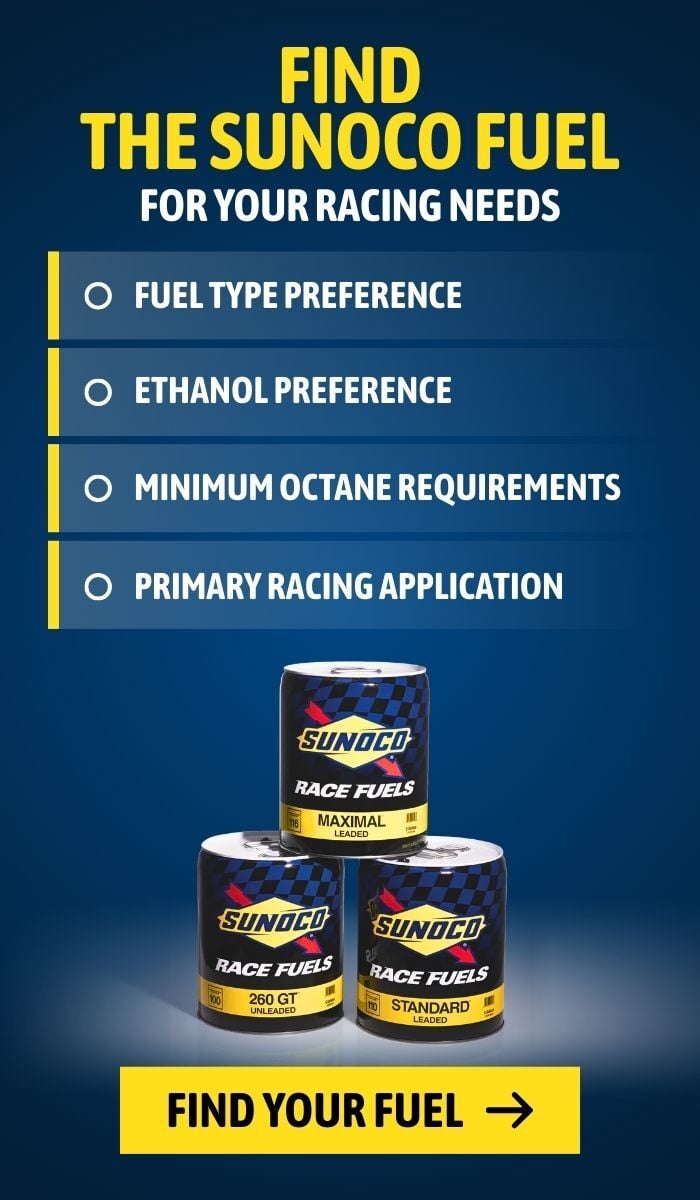
The Fuel Selector works through compression ratio, boost level, application type, and other parameters to confirm the right fuel for a specific combination. The Fuel Finder locates authorized dealers near any track. For combinations that need a direct conversation, Sunoco's technical team at 1-800-RACE-GAS handles those calls.