.svg)




How to Tell If Your Car Needs More Octane: Signs, Symptoms, and When to Upgrade Your Fuel
In motorsports, the pursuit of performance demands an exact understanding of every factor that influences how an engine behaves. Among these, few topics spark more discussion than octane. While most drivers are familiar with octane ratings from filling up at the pump, the stakes are very different when it comes to racing engines. These engines operate at the limits of compression, heat, and speed, and the margin between strong performance and catastrophic failure often comes down to whether the chosen fuel has the right octane level.
Octane is essentially a measure of how resistant a fuel is to knock or detonation, both of which occur when the air-fuel mixture ignites in an uncontrolled way. Instead of a steady burn moving the piston downward as designed, knock creates violent pressure spikes inside the cylinder. The result can range from lost efficiency and reduced power to damaged pistons and bearings. For a commuter vehicle with advanced sensors, knock is usually corrected before harm occurs. For a race engine tuned to the edge, it can end a race or an entire season in an instant.
The importance of octane lies in its connection to engine design. A stock road car with a moderate compression ratio may run without issue on 87 or 91 octane. A high compression race engine, or one using turbocharging or supercharging, demands much more resistance to knock. The higher the cylinder pressure, the more octane is required to maintain stable combustion. That is why racing fuels span a wide range of octane ratings, each intended for a specific balance of compression, boost, and operating conditions.
Understanding octane is not just about preventing failure. It is about unlocking the ability to tune an engine for its best possible performance. The right fuel provides room to optimize ignition timing, compression ratio, or boost levels without risking detonation. In this way, octane serves not only as protection but also as a tool that allows racers, tuners, and engine builders to push the boundaries of what their engines can achieve.
BREAKING DOWN OCTANE RATINGS
Octane ratings can be confusing because there are multiple methods for measuring them, and each method emphasizes different aspects of how a fuel behaves under pressure. The most common rating seen in the United States and Canada is the Anti-Knock Index, or AKI. This number is what appears on fuel pumps and is calculated as the average of two other tests: Research Octane Number (RON) and Motor Octane Number (MON). The formula is written as (R+M)/2.
RON is determined under relatively mild test conditions. It measures how fuel performs at lower engine speeds and temperatures, conditions similar to highway cruising. MON, on the other hand, is tested under harsher settings that simulate high load, high speed operation. MON values are typically lower than RON values for the same fuel because the test environment is more demanding. The AKI used in North America balances both perspectives, offering a practical number that reflects how the fuel will behave across a range of real-world conditions.
Internationally, RON is the most widely used standard. A driver importing or racing an overseas vehicle may encounter owner's manuals that specify fuel requirements in RON, which can cause confusion. For example, a European recommendation of 95 RON corresponds roughly to 91 AKI in the United States. Recognizing these differences is important, especially in motorsports where fuels may be sourced globally and tuning decisions are based on precise expectations.
Race fuels are labeled with their own octane ratings, but the principle remains the same: the higher the rating, the greater the resistance to knock under demanding conditions. What distinguishes race fuels from pump gasoline is not just the number on the label but the controlled chemistry behind it. While pump fuels can vary with season and location, race fuels are formulated to deliver stable and repeatable octane levels regardless of environment. For racers and engine builders, this consistency removes a critical variable when setting up a high performance engine.
THE RELATIONSHIP BETWEEN OCTANE, COMPRESSION, AND BOOST
The link between octane rating and engine design becomes clear when looking at compression ratio and forced induction. Both of these factors increase the pressure and temperature inside the combustion chamber. Higher pressure creates the potential for more power, but it also makes the air-fuel mixture more likely to ignite prematurely. This is why engines with high compression ratios or power adders like turbochargers and superchargers require fuels with higher octane ratings.
Compression ratio is a fundamental specification that indicates how much the air-fuel mixture is squeezed before ignition. A street car may run with a ratio of 9:1 or 10:1, while many race engines push beyond 12:1 or even 15:1. The greater the squeeze, the more energy can be extracted from combustion, provided the fuel can withstand the added stress without detonating. If the octane is too low for the setup, detonation becomes a real risk, and the result is lost horsepower, inconsistent performance, or mechanical damage.
Boosted engines face a similar challenge. Turbochargers and superchargers force additional air into the cylinders, raising both cylinder pressure and temperature. This effectively simulates a higher compression ratio, which means the octane demand rises accordingly. Without sufficient octane, the benefits of boost are offset by knock, forcing tuners to pull back timing and reduce power output. With the correct fuel, however, a boosted engine can safely take advantage of higher boost levels and produce significantly more horsepower.
The danger of insufficient octane in either scenario is not theoretical. Detonation under racing conditions can crack pistons, damage cylinder heads, and destroy bearings. For this reason, selecting the right octane is not just about maximizing performance—it is also about protecting the investment in an engine. By aligning octane rating with compression and boost levels, racers and engine builders can safely push engines to their designed limits, knowing that the fuel will support the demands placed on it.
SUNOCO'S OCTANE OPTIONS FOR RACE APPLICATIONS
Racing demands a wide range of fuels because no two engines are built the same. Factors like compression ratio, bore size, RPM limits, and the presence of turbocharging or nitrous oxide all influence what octane level an engine needs. For that reason, racing fuels are offered in different formulations, with octane ratings spanning from just above street premium to the very high levels required by extreme drag and endurance engines.
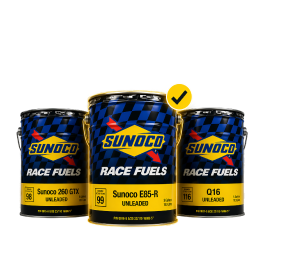
Unleaded racing fuels provide options for engines that rely on modern sensors and catalytic converters. Products such as 260 GT, with a 100 octane rating, are designed for high performance street cars and track-day machines that must remain emissions-compliant. For more demanding setups, 260 GT Plus raises the octane further with the help of additional oxygen content, making it a common choice for tuners pushing turbocharged or supercharged applications. Other unleaded fuels like Optima and Evo 10 serve niche needs, from long-term storage to highly oxygenated blends for maximum horsepower.
Leaded racing fuels extend the octane spectrum even higher. Traditional blends such as Standard (110 octane) and Supreme (112 octane) remain staples for small-block V8s, bracket racing, and engines running elevated compression. At the far end of the scale are fuels like MaxNOS and Maximal, rated at 116 octane, engineered to withstand the brutal pressures of engines running nitrous oxide, massive boost, or displacement combinations that stretch the limits of design. Specialized fuels such as SR18, at 118 octane, are intended for engines where cylinder pressures are so high that only the fastest burning, most knock-resistant fuels will survive.
These fuels are not interchangeable, and their differences go beyond just octane ratings. Each is blended for a specific purpose, taking into account factors like flame speed, oxygen content, and thermal stability. Choosing the right option means matching the chemistry of the fuel to the mechanical and tuning characteristics of the engine. When that match is correct, the fuel does more than prevent knock—it allows the engine to operate at its most efficient and powerful state.
OCTANE MYTHS AND MISCONCEPTIONS
Octane is often misunderstood, especially outside of professional racing circles. A common belief is that more octane automatically means more power. In reality, octane itself does not add energy to the fuel. What it does is allow an engine to operate at more aggressive settings—higher compression, advanced ignition timing, or elevated boost—without suffering from knock. If the engine is not designed or tuned to take advantage of those conditions, using a higher octane fuel will not result in extra horsepower.
Another misconception is that running too much octane can harm performance. While it is true that different fuels burn at different rates depending on their chemical makeup, the octane rating alone is not the cause of performance loss. If a particular blend has slower evaporation characteristics or does not match the engine's combustion chamber design, it may feel less responsive, but this is due to fuel formulation rather than the octane number itself. In most cases, excess octane provides a margin of safety rather than a drawback.
There is also confusion around mixing fuels. Some racers assume combining pump gas with race fuel will always deliver predictable results. In reality, the resulting octane will be a weighted average of the two, and if one of the fuels contains ethanol or other oxygenates, the blend may not behave as expected. Without precise knowledge of the mixture, tuning becomes uncertain, and engines can be exposed to greater risk than if a single, consistent fuel had been used.
These myths underscore the importance of viewing octane in context. It is not a magic ingredient that guarantees performance, nor is it a simple number to chase without understanding how it relates to compression, boost, and engine design. Correctly applied, octane is a safeguard and an enabler. Misapplied, it can lead to unnecessary expense or compromised performance. Racers who separate fact from misconception are better equipped to choose the right fuel and get the most out of their engines.
CONSISTENCY AND QUALITY CONTROL: SUNOCO'S DOUBLE DISTILLATION PROCESS
In racing, it is not enough for a fuel to carry the correct octane rating on paper. Engines are tuned with extreme precision, and even small variations in fuel chemistry can upset that balance. Consistency from batch to batch is therefore just as critical as the octane number itself. This is why specialized manufacturing processes are employed to ensure that every delivery of race fuel behaves identically, regardless of when or where it is purchased.
One of the defining methods for maintaining this consistency is double distillation. Unlike conventional refining, which may allow a wider spread of chemical components to enter the finished fuel, double distillation uses two stages of separation to isolate the most stable and predictable hydrocarbons. The result is a narrower chemical profile that resists variation. For racers, that means ignition timing and air-fuel ratios can be set with confidence, without the need to constantly retune for different batches of fuel.
The impact of this level of control is felt most in applications where engines are pushed to their absolute limits. A drag car running at 9,000 rpm with a high compression ratio or a boosted engine tuned for maximum output has little tolerance for uncertainty. If the fuel deviates from expected properties, it can lead to detonation or incomplete combustion. With a tightly controlled process like double distillation, these risks are minimized, and performance remains predictable.
Beyond reliability on race day, this consistency also supports long-term engine health. Stable fuels create fewer deposits, reduce the chances of hot spots inside the combustion chamber, and help maintain clean injector and valve operation. For both professional teams and weekend racers, the assurance that every batch of race fuel will match the last is a critical factor in both performance and durability. In this way, octane is not just about the number, but about the reliability of how that number is delivered.
CHOOSING THE RIGHT OCTANE FOR YOUR RACE PROGRAM
Selecting the right fuel starts with understanding the demands of the engine itself. Compression ratio is often the first consideration. Higher compression increases cylinder pressure and heat, both of which demand greater knock resistance. Engines operating above 12:1 compression, for example, often require fuels above 110 octane, while milder race builds may run effectively on fuels in the high 90s or low 100s. Bore size and combustion chamber design also influence this requirement, since larger chambers mean the flame front must travel farther and are more prone to detonation if octane is insufficient.
Forced induction adds another layer to the equation. Turbocharged and supercharged engines generate cylinder pressures that mimic or exceed those of high-compression naturally aspirated setups. In these cases, octane selection must account for both the static compression ratio and the level of boost being applied. Nitrous oxide systems create similar challenges, rapidly increasing combustion temperatures and requiring fuels with greater resistance to uncontrolled ignition. Without the right octane level, these combinations can push engines beyond their safe operating range.
RPM range is another factor. Engines designed to spin well beyond 7,000 rpm benefit from fuels with faster burn speeds and stable combustion characteristics. A fuel that resists knock at lower engine speeds may not deliver clean, consistent combustion at higher revs. This is why race fuels vary not only in octane rating but also in formulation, with some optimized for rapid evaporation and flame propagation at high engine speeds.
Tuning is the final piece. Modern race engines are rarely "one size fits all." The right octane provides the flexibility to advance ignition timing, adjust boost, or lean out fuel mixtures for added power, all without risking detonation. Choosing a fuel that matches the specific demands of the build means the engine can be tuned for peak performance rather than limited by fuel constraints. In practice, this means working closely with tuners and engine builders, considering the unique combination of hardware and conditions, and then selecting the octane rating that ensures both reliability and maximum output.
CONCLUSION: TRUSTING OCTANE ACCURACY IN RACING
Octane is far more than a number on a pump or a label on a drum. For race engines, it represents the fine line between controlled, repeatable performance and the destructive effects of knock. Understanding what octane measures, how it is rated, and why different engines require specific levels is essential knowledge for anyone competing at a serious level. High compression ratios, forced induction, and elevated RPMs all increase the demand for stable, knock-resistant fuel, and choosing correctly is as much about protecting an engine as it is about unlocking its full potential.
Racers also face the reality that octane is only meaningful if it is consistent. A label may promise a certain number, but if the fuel varies from batch to batch, tuning becomes unpredictable and performance suffers. This is why precision blending and strict quality control matter just as much as the octane rating itself. The ability to trust that the number on the drum will deliver the same performance every time removes uncertainty and allows builders and drivers to focus on racing rather than fuel concerns.
In the end, selecting the right octane is not about chasing the highest rating possible. It is about making an informed decision that matches fuel chemistry to engine design, compression, boost, and intended use. By treating octane as both a safeguard and a tool, racers can push their machines to the limit with confidence, knowing the foundation of their performance is stable combustion under pressure. In a sport where fractions of a second decide outcomes, that reliability is as valuable as horsepower itself.
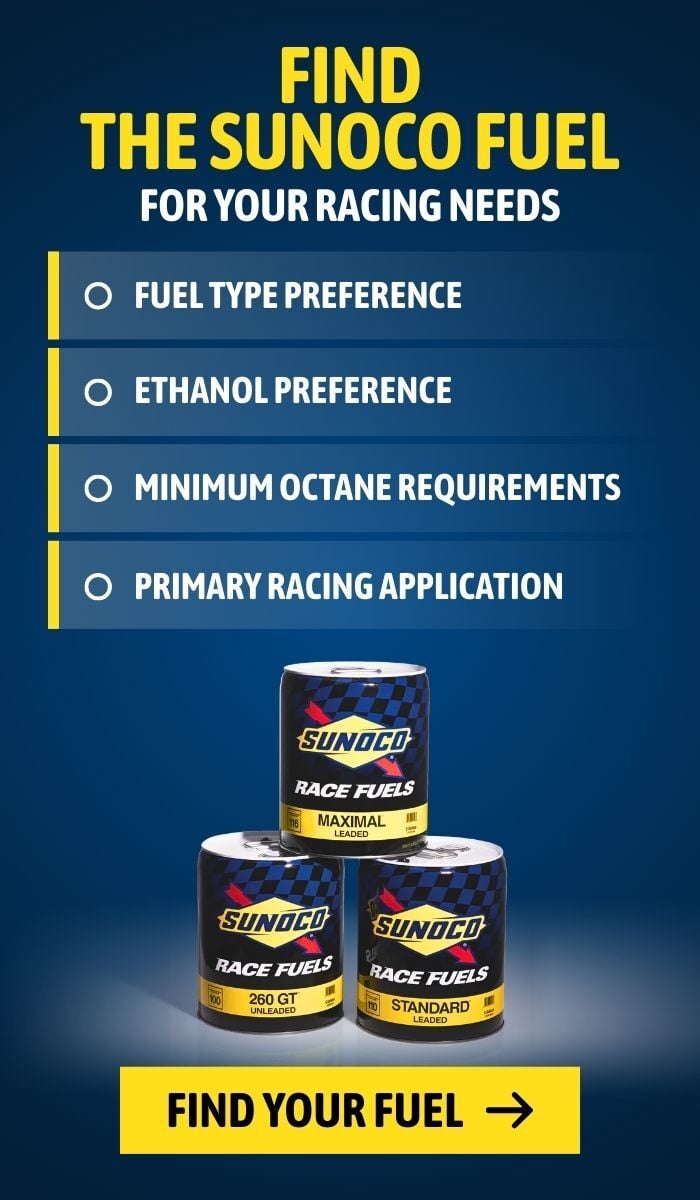
Ready to find the right fuel for your race program? Visit the Sunoco Fuel Selector or use the Fuel Finder to locate a dealer near you.