.svg)




How to Tell If Your Car Needs More Octane: Signs, Symptoms, and When to Upgrade Your Fuel
The Aviation Fuel Appeal
The aviation fuel conversation resurfaces regularly in racing circles, message boards, and garage discussions. Someone mentions that their local airport sells 100LL avgas for less per gallon than race fuel. Another racer recalls their grandfather running avgas in a circle track motor decades ago without issues. A budget-conscious team faces a choice between expensive race fuel and readily available aviation gasoline at the small airport ten miles from the track.
Aviation fuel, particularly 100LL (100 octane low lead), maintains persistent appeal among certain racing segments for understandable reasons. Small airports across the country stock it reliably, making it geographically accessible even in remote areas where race fuel distributors don't operate. The "100 octane" designation on the pump suggests high performance capability. Stories of aviation fuel's purity and consistency, its origins in demanding aircraft applications, and its historical use in racing create an aura of legitimacy that attracts racers seeking alternatives to purpose-built race fuel.
Common scenarios drive racers toward aviation fuel consideration. Budget-constrained programs operating on minimal sponsorship view the cost difference between avgas and race fuel as potentially race-saving. Teams competing in remote locations without convenient access to race fuel suppliers see aviation fuel as their most practical high-octane option. Older engines originally built and tuned decades ago when avgas saw more common racing use sometimes continue on that fuel simply because "it's what we've always run."
However, aviation fuel is engineered specifically for aircraft engines operating under aircraft conditions, not high-performance automotive race engines pushing the boundaries of power density, RPM, and transient load. While avgas may allow an engine to run, it introduces performance compromises, tuning challenges, and long-term risks that undermine the consistency and optimization of serious racing demands. Understanding why aviation fuel falls short for racing applications helps explain why purpose-built race fuels represent the correct solution despite higher costs or reduced convenience.
What Is Aviation Fuel (Avgas)?
Aviation gasoline serves the piston-engine aircraft fleet, primarily small general aviation planes still operating with reciprocating engines rather than turbines. The Federal Aviation Administration oversees avgas specifications and distribution, ensuring fuel meets stringent requirements for aircraft safety and reliability.
The most commonly discussed grade in racing contexts is 100LL, where "100" indicates the octane rating and "LL" means "low lead" relative to historical aviation fuels that contained even higher lead concentrations. Other grades exist for specific aircraft applications, but 100LL dominates the general aviation fuel market and represents the product racers typically encounter at airports.

Aviation fuel prioritizes characteristics essential for aircraft operation but fundamentally different from racing requirements. Detonation resistance at constant RPM matters critically for aircraft engines that may cruise at fixed power settings for hours. An aircraft engine maintaining 2,500 RPM at 75% power for a three-hour cross-country flight demands fuel that resists knock consistently under those steady-state conditions without degradation or variability.
Stability at high altitude and low temperatures reflects the operating environment aircraft encounter. Planes routinely fly at altitudes where atmospheric pressure drops to half sea-level values and temperatures plunge well below freezing. Fuel must vaporize adequately for smooth combustion despite thin, cold air. Vapor lock risks increase at altitude due to reduced atmospheric pressure, demanding carefully controlled vapor pressure characteristics different from ground-level racing requirements.
Long-term storage stability addresses how aircraft operate. Private planes may sit for weeks or months between flights. Fuel remaining in aircraft tanks between flying sessions must maintain specifications without degrading, forming deposits, or absorbing moisture. This storage stability requirement influences formulation decisions about hydrocarbon selection and additive packages.
These priorities diverge substantially from racing applications. Race engines experience violent RPM swings from idle to redline in seconds. Cylinder pressures spike during acceleration rather than holding steady. Engines operate at or near sea level atmospheric pressure rather than altitude conditions. Fuel typically gets consumed within days or weeks rather than sitting for months. The operating environment and performance demands differ so fundamentally that fuel optimized for aircraft necessarily compromises racing performance.
Octane Ratings: Why Avgas Numbers Are Misleading
The "100" octane designation on aviation fuel creates dangerous misunderstandings about how avgas performs in racing engines. Aviation fuel octane measurement uses different testing methods than automotive fuel, making direct comparisons between avgas octane numbers and race fuel ratings misleading at best and potentially catastrophic at worst.
Aviation fuel octane testing evaluates performance under both lean and rich mixture conditions, recognizing that aircraft engines operate across a range of mixture settings depending on altitude and power requirements. The lean rating measures detonation resistance when running lean mixtures, while the rich rating evaluates performance at richer settings. These dual ratings reflect aircraft operating conditions where mixture strength varies with altitude and pilot technique.
The complex relationship between aviation octane measurement and automotive octane ratings means that "100LL" avgas does not equate to 100 octane race fuel as measured by the (R+M)/2 method used for automotive applications. The testing procedures, operating conditions, and measurement criteria differ enough that assuming direct equivalence creates false expectations about knock resistance and safe compression ratios.
Studies of fuel performance demonstrate that avgas octane behavior under racing conditions often differs from what the aviation rating suggests. The constant-RPM, steady-state conditions of aviation octane testing don't replicate the transient loads, rapid throttle movements, and high cylinder pressures that characterize racing. An engine that runs safely on 100LL during steady cruising might detonate under racing acceleration despite the fuel's "100" rating.
This misunderstanding leads to improper compression matching where engine builders assume 100LL provides equivalent knock protection to 100 octane race fuel. Compression ratios selected based on this false equivalence may push engines beyond safe detonation margins, risking catastrophic damage. The resulting false detonation safety assumptions create dangerous situations where racers believe they have adequate octane protection when actual margins are dangerously thin.
Inconsistent tuning results plague engines running avgas because the octane behavior doesn't match what tuners expect from properly rated automotive race fuel. Timing advances that should be safe produce knock. Boost levels that theoretical calculations suggest are acceptable, cause detonation. The disconnect between aviation octane ratings and racing performance realities forces conservative tuning that leaves power on the table or aggressive tuning that risks engine damage.
Professional engine builders and tuners familiar with both aviation fuel and race fuel consistently report that 100LL performs more like 91-93 octane automotive fuel under racing conditions rather than true 100 octane race fuel. This effective octane shortfall of 7-9 points dramatically limits the compression ratios, boost levels, and timing advances that engines can safely use when running avgas instead of purpose-built race fuel.
Burn Rate and Combustion Mismatch
Beyond octane considerations, aviation fuel's fundamental combustion characteristics create performance compromises in racing engines. The burn rate, flame propagation speed, and combustion pressure development that optimize aircraft engine operation differ significantly from what racing engines need for maximum power and response.
Aviation fuel formulation targets long-duration, steady-state operation where engines maintain constant RPM and load for extended periods. The fuel's burn characteristics optimize smooth, predictable combustion at fixed operating points rather than rapid transient response. Flame propagation proceeds at rates appropriate for the relatively gentle pressure rise rates aircraft engines experience during stable cruise flight.
Racing engines demand entirely different combustion behavior. Rapid throttle transitions from part-throttle to wide-open occur in fractions of a second. Cylinder pressure spikes violently during acceleration as engines climb from mid-range to peak RPM under full load. Aggressive ignition timing curves attempt to initiate combustion as early as possible without inducing knock, requiring fuel that burns quickly and completely within the limited time available before the exhaust valve opens.
Aviation fuel's burn characteristics cause several performance problems in racing applications. Slower flame propagation means combustion continues later into the expansion stroke, reducing the cylinder pressure peak that drives the piston downward and generates torque. The delayed combustion also means more heat transfers to cylinder walls, heads, and exhaust rather than converting to mechanical work. The net result is reduced torque response across the RPM range, particularly noticeable in the mid-range and during acceleration.
Racers running avgas frequently report that engines feel "flat" or lacking the crisp throttle response achieved with proper race fuel. Dyno testing often confirms measurable power losses of 3-8% compared to equivalent octane race fuel, with losses concentrated in the torque curve's critical mid-range region. While peak horsepower at maximum RPM might show smaller deficits, the area under the torque curve suffers, reducing acceleration and overall performance.
The combustion mismatch also affects ignition timing optimization. Aviation fuel's slower burn rate would theoretically benefit from more timing advance to compensate for delayed combustion completion. However, the practical octane limitations of avgas in racing conditions prevent aggressive timing advances, creating a double bind where the fuel needs more timing than it can safely tolerate. Tuners end up compromising, accepting slower combustion and its power penalties rather than risking detonation from excessive advance.
Comparing the combustion characteristics optimized in purpose-built race fuels reveals why aviation fuel struggles in racing applications. Race fuel formulations balance burn rate, flame speed, and pressure development specifically for high-RPM transient operation. The hydrocarbon selections, additive packages, and blending strategies all target the violent, rapidly changing conditions inside racing combustion chambers rather than the steady-state environment of aircraft engines.
Lead Content and Modern Engine Issues
100LL aviation fuel contains substantial lead content, with concentrations approximately twice those found in leaded race fuels. While lead serves valuable purposes in aviation applications, its high concentration creates multiple problems in racing and performance engines that modern designs were never intended to accommodate.
Lead's primary role involves providing octane boost and valve seat protection in engines lacking hardened valve seats. Aircraft engines, many designed in the 1940s through 1960s, benefit from lead's lubricating properties on valve faces and seats during the long-duration operation aircraft demands. The steady-state cruise conditions allow lead deposits to form protective layers that prevent valve recession and wear during thousands of hours of operation.
Racing engines operate under fundamentally different conditions that turn lead's benefits into liabilities. High-RPM operation creates more lead deposits per unit time than aircraft engines accumulate. The deposits form faster, accumulate more heavily, and create problems that rarely affect aircraft engines running at moderate RPM in cruise flight.
Spark plug fouling emerges as one of the most immediate issues. Lead deposits accumulate on spark plug insulators, electrodes, and in the plug's firing cavity. These deposits eventually create electrical paths that short-circuit the spark plug, causing misfires that reduce power and create rough running. Aircraft spark plugs are designed for lead-contaminated environments and typically feature different heat ranges and construction than racing plugs. Using standard racing spark plugs with high-lead avgas dramatically reduces plug life and increases the frequency of plug fouling problems.
Oxygen sensor damage occurs rapidly when modern fuel-injected racing engines run high-lead aviation fuel. Wide-band oxygen sensors used for precise air-fuel ratio monitoring contain sensing elements that lead exposure permanently damages. The lead coats the sensor's internal surfaces, rendering it unable to provide accurate readings. Teams running avgas in oxygen sensor-equipped engines face either frequent expensive sensor replacements or operating without the closed-loop mixture feedback that modern tuning depends upon.
Catalytic converter destruction happens instantly if any vehicle equipped with emissions control equipment runs leaded aviation fuel. Even brief operation on leaded fuel permanently poisons catalyst materials, rendering the converter useless. While pure race cars rarely carry catalytic converters, street-strip vehicles and performance cars used on public roads cannot run leaded avgas without destroying emissions equipment worth hundreds or thousands of dollars.
The lead content in aviation fuel was never designed for high-RPM racing cycles where combustion events occur thousands of times per minute. Aircraft engines typically operate between 2,000-2,800 RPM during cruise, experiencing perhaps 1,500 combustion events per minute per cylinder. Racing engines routinely exceed 6,000-9,000 RPM, creating 3,000-4,500 combustion events per minute per cylinder or more. This dramatically increased combustion frequency accelerates lead deposit formation beyond anything aviation fuel formulation anticipated.
Frequent teardown intervals common in racing reveal another incompatibility. Aircraft engines run hundreds or thousands of hours between overhauls, allowing time for lead deposits to stabilize and form protective layers. Racing engines often face inspection and freshening after every event or few events. The short service intervals mean lead deposits never reach equilibrium conditions, instead existing in constantly evolving states that create unpredictable effects on combustion chamber surfaces and valve sealing.
Modern fuel injection systems compound lead compatibility issues. Fuel injectors spray fuel in fine patterns that lead deposits can disrupt. Fuel pressure regulators contain diaphragms and small orifices that lead contamination affects. Mass airflow sensors and manifold pressure sensors that lead vapor exposure can damage or corrupt become additional failure points. Aviation fuel's high lead content creates reliability risks throughout modern fuel delivery systems that aircraft engines with their simpler carburetor-based fuel metering don't encounter.
Vapor Pressure and Throttle Response Problems
Aviation fuel vapor pressure optimization serves aircraft operating requirements rather than racing performance needs. The resulting vapor pressure characteristics create several problems that affect racing engine driveability, throttle response, and consistency under typical racing conditions.
Aircraft require fuel that vaporizes adequately at altitude where atmospheric pressure drops significantly below sea-level values. As planes climb, the reduced pressure makes all liquids more prone to vaporization. Fuel system designers must prevent vapor lock while ensuring adequate fuel atomization for smooth combustion in thin air. These competing demands result in vapor pressure specifications different from what racing applications need.
The vapor pressure compromises aviation fuel makes for altitude operation create issues in racing environments operating at or near sea level. Hot-restart behavior suffers particularly in heat-soaked conditions. After shutting down a race engine that has been running hard, underhood temperatures soar as heat dissipates from exhaust manifolds, cylinder heads, and the block. Fuel cells, lines, and carburetors absorb this heat, raising fuel temperature well above ambient.
Aviation fuel's vapor pressure characteristics, optimized for high-altitude operation, can create excessive vapor formation during hot restarts. The fuel vaporizes too readily in the hot fuel system, creating vapor pockets that interfere with fuel delivery. Carbureted engines particularly struggle with hot restart on avgas as vapor-filled fuel bowls prevent adequate liquid fuel from reaching jets and circuits. The engine cranks but won't fire, or fires briefly then dies as vapor clears and refills, creating frustrating hot-restart delays in the pits.
Sluggish throttle response plagues racing engines on aviation fuel compared to the crisp response achieved with properly formulated race fuel. The vapor pressure characteristics affect fuel atomization and vaporization rates in ways that delay throttle response. When the driver opens the throttle, the engine requires immediate fuel delivery and vaporization to match the increased air flow. Aviation fuel's vapor pressure behavior doesn't optimize for this rapid transient, creating a slight lag between throttle opening and power delivery that compounds with the combustion mismatch issues discussed earlier.
Inconsistent mixture delivery in carbureted engines stems partly from vapor pressure variability. Carburetor calibration assumes predictable fuel vaporization behavior that allows consistent mixture delivery across varying conditions. Aviation fuel vapor pressure, optimized for altitude changes rather than temperature variations at constant altitude, behaves differently than race fuel as underhood temperatures fluctuate during racing operation. Jets sized for cold fuel deliver different effective mixtures when fuel temperature rises, creating tuning inconsistency that frustrates racers seeking optimal performance.
These vapor pressure issues matter most in specific racing disciplines. Drag racing creates severe heat-soak conditions between rounds as vehicles sit in staging lanes with hot engines and no cooling airflow. The combination of high underhood temperatures, extended soak time, and critical need for immediate response during the next run amplifies every vapor pressure shortcoming aviation fuel exhibits.
Circle track racing faces similar challenges with prolonged idling in pit lanes, hot restarts after caution periods, and the need for instant throttle response when exiting corners. Aviation fuel's vapor pressure behavior creates problems in precisely the situations where consistent fuel delivery matters most for lap times and race results.
Heat-soaked pit conditions affect all racing disciplines but become particularly problematic with aviation fuel. The paddock area at summer races can exceed 100°F ambient temperature. Race cars sitting between sessions with exhaust heat radiating from components create localized temperatures well above ambient. Under these conditions, aviation fuel's vapor pressure characteristics designed for altitude operation become liabilities that compromise reliability and consistency.
Understanding Reid vapor pressure helps explain why purpose-built race fuels optimize this specification for ground-level racing conditions rather than the altitude changes aircraft encounter. Race fuel vapor pressure targets consistent liquid fuel delivery across the temperature ranges racing creates without excessive vaporization that causes hot-restart problems or vapor lock under heat soak.
Fuel Consistency vs Application-Specific Consistency
Aviation fuel advocates correctly note that avgas offers excellent consistency compared to pump gasoline. Batches of 100LL from different airports or different dates typically meet tight specifications that provide predictable behavior in aircraft engines. This consistency represents one of aviation fuel's genuine strengths and helps explain its appeal to racers frustrated by pump gas variability.
However, consistency alone does not equal suitability for racing applications. Aviation fuel remains consistently optimized for aircraft operating conditions, not racing performance. The fuel delivers predictable behavior within parameters that matter for aircraft but don't align with what racing engines need. Being consistently wrong for racing represents no advantage over being variably correct.
Race fuels achieve consistency within racing-specific parameters that directly affect performance optimization. Specific gravity remains tightly controlled to ensure accurate fuel metering and consistent mixture delivery. Carburetor jetting established with fuel of known density continues working correctly because every batch matches that density within minimal variation. Fuel injection calibrations remain accurate because the fuel mass delivered per unit volume doesn't shift between batches.
Vapor pressure control ensures predictable fuel delivery characteristics across varying temperature conditions racing creates. Hot weather races don't suddenly produce vapor lock because this batch of fuel has higher vapor pressure than the previous one. Cold morning qualifying sessions don't create hard-starting issues because vapor pressure hasn't dropped in this fuel lot. The consistency enables optimized calibrations to remain valid rather than requiring constant adjustment for fuel property variations.
Burn speed consistency allows ignition timing optimization to stay relevant from one race to the next. Engines tuned for optimal timing with known burn rate characteristics continue performing correctly because the fuel's combustion behavior remains stable. Racers don't encounter situations where timing that prevented knock last month now causes detonation because fuel burn rate changed, or where timing that produced peak power previously now leaves power on the table because the fuel burns differently.
Detonation behavior under transient load represents another critical consistency parameter for race fuels. The fuel resists knock predictably under the acceleration, high-RPM, and peak-load conditions racing creates. Compression ratios, boost levels, and timing advances selected based on the fuel's knock resistance remain valid because that knock resistance doesn't vary batch to batch. Engine builders can push combinations to the edge knowing the fuel will deliver consistent protection.
Using aviation fuel that's consistently optimized for the wrong application still leads to inconsistent racing performance. The mismatch between avgas characteristics and racing requirements creates unpredictable effects that vary with operating conditions even though the fuel itself stays consistent. Different ambient temperatures, varying heat-soak scenarios, and diverse racing loads interact with aviation fuel's aircraft-optimized properties in ways that produce inconsistent racing results despite the fuel's internal consistency.
Professional racing teams recognize that the right kind of consistency matters more than consistency for its own sake. Purpose-built race fuels from Sunoco maintain rigorous consistency within specifications that directly impact racing performance. The consistency serves the application rather than simply existing as an abstract quality.
Why AV Fuel Sometimes "Seems to Work"
Despite aviation fuel's fundamental mismatches with racing requirements, many racers report running avgas apparently successfully. Understanding when and why aviation fuel appears adequate helps clarify when it represents acceptable compromise versus hidden performance sacrifice.
Low-RPM engines operating well below their potential stress levels can run acceptably on aviation fuel. A mild street performance engine with 9.5:1 compression running occasional track days at 5,500 RPM redline doesn't challenge fuel properties severely. The modest compression, limited RPM, and conservative operation fall well within aviation fuel's capabilities even though the fuel isn't optimized for these conditions. The engine runs adequately because it operates far enough from detonation thresholds and performance limits that fuel shortcomings don't cause obvious problems.
Older, lower specific-output engine combinations from decades past when racing technology was less sophisticated sometimes continue on aviation fuel because they were originally developed with it. Circle track engines from the 1970s or 1980s built to 11:1 compression and 6,500 RPM might run acceptably on 100LL because they were designed around that fuel's limitations. Ignition timing, compression ratio, and camshaft selection all reflect compromises necessary for avgas compatibility. These engines run adequately on aviation fuel not because avgas performs well but because the entire combination was built to work within its constraints.
Engines operating far from their detonation threshold with substantial octane safety margins represent another scenario where aviation fuel seems acceptable. An engine that could safely run 12:1 compression on proper race fuel but was conservatively built to 10:1 for reliability has octane to spare. Running 100LL in this engine might work adequately because even with avgas's effective octane shortfall, sufficient detonation margin remains. The engine runs safely though it sacrifices potential performance that higher compression with proper fuel would provide.
The critical distinction involves recognizing that "running" doesn't equal "running optimally." An engine that starts, idles, accelerates, and completes races on aviation fuel meets minimum functionality requirements. However, this basic operation masks several hidden costs that compromise competitive performance.
Lost power represents the most obvious hidden cost. Dyno testing consistently reveals that engines produce less torque and horsepower on aviation fuel compared to equivalent or lower octane race fuel properly formulated for automotive racing. The power deficit might only amount to 3-5%, which seems modest but translates to meaningful performance differences in competitive racing. A 500-horsepower engine losing 5% surrenders 25 horsepower that competitors using proper fuel retain.
Reduced tuning window constrains optimization efforts. The combination of questionable effective octane, mismatched burn characteristics, and vapor pressure compromises forces conservative tuning that leaves performance potential unrealized. Timing advances that proper race fuel would safely accommodate must be avoided. Compression ratios that would extract more power cannot be used. The engine never achieves its full potential because fuel limitations prevent optimization.
Increased maintenance stems from lead deposits, plug fouling, and the general strain of operating on fuel not designed for the application. Spark plugs require more frequent replacement. Combustion chambers need more frequent cleaning. Valve and valve seat wear potentially accelerates. While individual maintenance items might seem minor, accumulated over a season the extra service time and parts costs erode the cost savings aviation fuel's lower price initially promised.
The false economy of aviation fuel becomes apparent when accounting for total costs rather than just fuel price per gallon. Cheaper fuel that costs more in lost performance, increased maintenance, and tuning compromises doesn't actually save money. Professional teams universally choose purpose-built race fuel not because they're unconcerned about costs but because they recognize that proper fuel represents the most cost-effective path to competitive performance and reliable operation.
Better Alternatives for Racing Applications
Rather than accepting aviation fuel's compromises, racers benefit from exploring purpose-built alternatives designed specifically for automotive racing conditions and requirements. Modern race fuel technology addresses the shortcomings aviation fuel exhibits while providing characteristics that optimize racing performance.
Purpose-built race fuels target automotive combustion dynamics rather than aircraft operating conditions. The burn rates, flame propagation speeds, and pressure development characteristics match what high-RPM racing engines need for optimal power production. Rapid throttle response becomes possible because fuel formulation anticipates violent transient loads rather than steady-state cruise operation. Ignition timing can be optimized aggressively because the fuel's knock resistance reflects actual racing conditions rather than aviation test procedures.
Consistent air-fuel ratios result from race fuel properties designed for accurate metering in automotive fuel systems. Specific gravity control ensures carburetors deliver predictable mixture ratios and fuel injection systems meter accurately. Vapor pressure optimization prevents vapor lock while maintaining consistent liquid fuel delivery across temperature variations racing creates. The result is tuning stability that aviation fuel's aircraft-optimized properties cannot match.
Predictable ignition timing response allows tuners to develop optimized calibrations that remain valid from one race to the next. The fuel's knock resistance under racing loads means compression ratios, boost levels, and timing advances selected based on the fuel's specifications actually work as intended. No surprises emerge where engines detonate despite theoretical octane adequacy or fail to respond to timing changes the way testing predicted.
Matching fuel choice to specific engine requirements optimizes both performance and reliability. Compression ratio considerations guide selection of appropriate octane levels that provide necessary knock protection without paying for excess octane the engine cannot utilize. Engine design factors like combustion chamber shape, squish clearance, and cooling system efficiency all influence ideal fuel selection. Racing environment considerations such as ambient temperature, altitude, and discipline-specific demands further refine optimal choices.
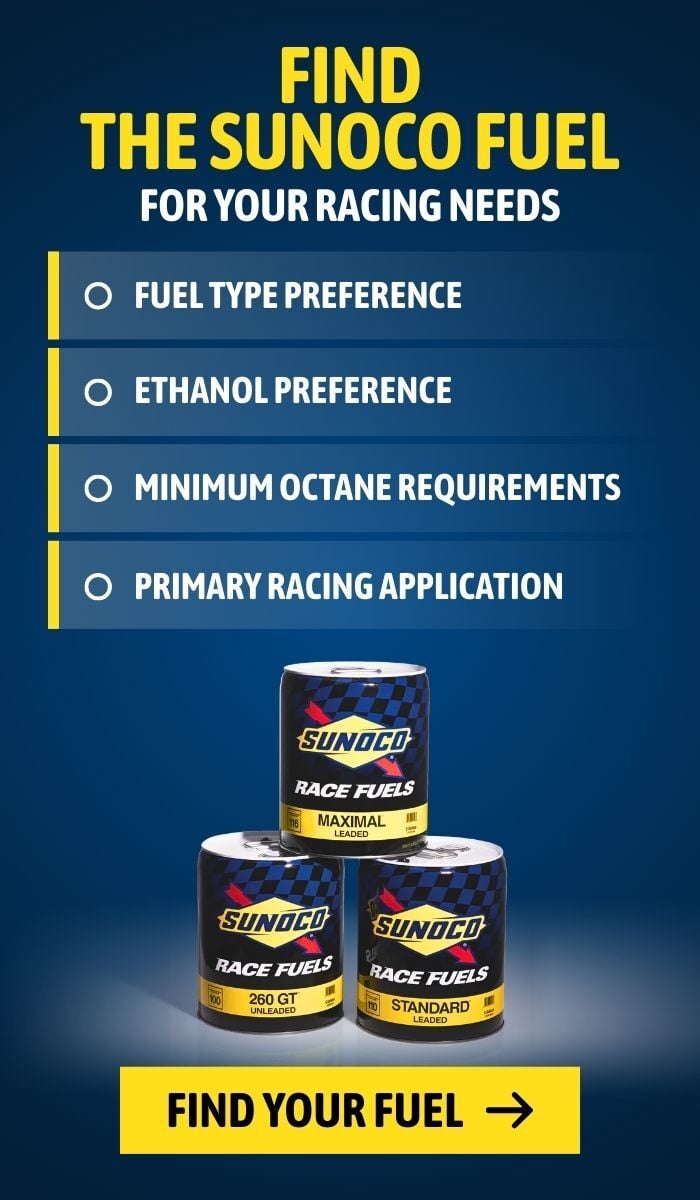
Sunoco race fuels address racing requirements through comprehensive specification control and formulation strategies developed specifically for motorsports applications. Products like Sunoco Standard provide 110 octane in leaded formulation for race engines where lead is permitted and valve seat protection is desired. Sunoco 260 GT delivers 100 octane unleaded for modern race engines, street-strip vehicles, and applications requiring unleaded fuel. Sunoco Maximal steps up to 114 octane for demanding applications pushing extreme compression or boost.

Known octane behavior under racing conditions eliminates the guesswork and false assumptions aviation fuel's misleading octane ratings create. When Sunoco Standard specifies 110 octane, that rating reflects performance under automotive testing procedures and racing loads rather than aircraft conditions. Engine builders can select compression ratios and tuners can advance timing based on ratings that accurately predict knock resistance in actual racing operation.
The Double Distilled refining process Sunoco employs ensures batch-to-batch consistency that keeps calibrations valid throughout racing seasons. The fuel a team purchases in March performs identically to the fuel they buy in September, eliminating fuel variability as a tuning variable and allowing optimized setups to remain relevant across entire championships.
For racers concerned about fuel costs, the economics favor purpose-built race fuel when accounting for total program costs rather than just fuel price. The performance gained through optimal fuel selection, the maintenance savings from avoiding lead-related problems, and the tuning efficiency from working with fuel designed for the application all contribute value that offsets higher per-gallon costs. Competitive teams recognize that fuel represents a small percentage of total racing budgets while directly enabling or limiting the performance all other investments aim to achieve.
The Bottom Line: Aviation Fuel Is a Compromise, Not a Solution
Aviation fuel solves availability problems and may provide cost advantages in specific situations, but it doesn't solve performance problems or optimize racing engine operation. The fundamental engineering reality is that 100LL was designed for aircraft engines operating under aircraft conditions, and that design optimization creates numerous compromises when applied to automotive racing engines pursuing maximum performance.
The operating environment aircraft and racing engines face differs so dramatically that fuel optimized for one necessarily compromises the other. Steady-state cruise at fixed RPM versus violent transient loads and RPM swings. Altitude changes from sea level to 10,000 feet versus operation consistently near ground level. Extended operation at moderate cylinder pressures versus brief bursts at extreme pressures. Long periods between maintenance versus frequent inspection and service. Every aspect of aircraft operation that influenced aviation fuel formulation conflicts with racing requirements.
Modern race fuels eliminate the guesswork, tuning inconsistency, and performance compromises aviation fuel imposes. Purpose-built formulations optimized specifically for racing provide the specifications engines need for reliable detonation protection, optimal combustion characteristics, and predictable behavior under varying racing conditions. The investment in proper fuel enables rather than limits performance potential.
Professional racing programs universally choose race fuel over aviation fuel despite any cost or convenience advantages avgas might offer. This preference reflects hard-won understanding that fuel represents the foundation upon which all other performance modifications build. The best cylinder heads, most sophisticated engine management, and most skilled tuning cannot fully compensate for fuel that wasn't designed for the application. Conversely, proper fuel allows well-prepared engines to achieve their full potential reliably and consistently.
For racers evaluating whether aviation fuel represents acceptable compromise, the question ultimately reduces to goals and priorities. If availability and cost constraints make aviation fuel the only practical option, understanding its limitations allows informed decisions about engine building and tuning approaches that work within those constraints. Conservative compression ratios, careful tuning, and acceptance of modest performance targets become necessary accommodations.
However, if the goal involves reliability, repeatability, and maximum performance within engine design limits, purpose-built race fuel is the correct tool for the job. The specifications, consistency, and optimization race fuel provides enable competitive performance and reliable operation that aviation fuel's compromises prevent achieving. The choice between barely adequate and truly optimal becomes clear when performance matters and competitive success depends on extracting every available advantage.
Understanding what octane actually measures, recognizing how fuel properties affect engine behavior, and appreciating why consistency across specifications matters all contribute to informed fuel selection decisions. Aviation fuel may run an engine, but running and running optimally represent fundamentally different outcomes. For racers serious about performance, the solution is clear: choose fuel engineered for racing, not aviation.