.svg)




How to Tell If Your Car Needs More Octane: Signs, Symptoms, and When to Upgrade Your Fuel
What Changes at 110 Octane?
The jump from 100 to 110 octane represents more than incremental improvement. It marks a meaningful threshold in racing fuel selection. Where 100 octane serves the crossover territory between aggressive street performance and weekend racing, 110 octane enters the dedicated motorsports domain where engine builds prioritize maximum output over streetability concerns.
This distinction matters because choosing between 100 and 110 octane is not simply about buying more knock resistance. The decision reflects fundamental questions about engine specifications, racing application, and performance goals. Engines requiring 110 octane have typically outgrown the capabilities that make 100 octane adequate. Compression ratios climb into ranges that street engines rarely explore. Boost pressures exceed levels that occasional track day cars experience. Ignition timing advances push boundaries that conservative calibrations avoid.
Octane rating itself is measured using the industry-standard (R+M)/2 method, averaging the Research Octane Number (RON) and Motor Octane Number (MON) as defined by ASTM D2699 and D2700. The RON test evaluates fuel under milder conditions while the MON test simulates more severe high-speed operation. Together these measurements define a fuel's resistance to detonation across a range of real-world scenarios. At 110 octane, that resistance is meaningfully greater than what 100 octane provides, and the difference becomes critical once engine specifications push past specific thresholds.
Understanding what changes at 110 octane helps racers recognize when they have reached the threshold where current fuel limits performance potential. The transition from 100 to 110 octane often accompanies transitions in racing seriousness, engine investment, and competitive goals. Weekend warriors running street-strip combinations rarely need 110 octane's capabilities. Serious competitors building dedicated race engines to extract maximum power frequently find 110 octane represents minimum acceptable protection rather than a luxury upgrade.
The engine combinations that demand 110 octane share common characteristics that distinguish them from milder applications 100 octane serves adequately. Static compression ratios approach or exceed 12:1 in naturally aspirated configurations, creating cylinder pressures and temperatures that challenge even premium race fuel. Forced induction setups push boost pressures into ranges where turbocharger or supercharger output dominates naturally aspirated compression effects. Ignition timing maps become increasingly aggressive as tuners pursue every available degree of advance that higher octane fuel safely supports.
Professional engine builders recognize specific thresholds where 100 octane transitions from adequate to marginal. These breaking points vary with combustion chamber design, cooling system efficiency, fuel quality consistency, and dozens of other variables. However, patterns emerge across thousands of successful engine combinations that guide specifications toward appropriate fuel selection. The 12:1 compression threshold for naturally aspirated engines and 18 psi boost level for forced induction represent approximate transition points where 110 octane becomes beneficial or necessary for most applications.
Racing disciplines themselves influence when 110 octane makes sense regardless of absolute engine specifications. Circle track racing where sustained high-RPM operation under load continues for hundreds of laps creates thermal conditions that challenge knock resistance more severely than brief drag racing passes. Road racing endurance events push similar sustained load scenarios. These applications might specify 110 octane even when compression ratios or boost pressures fall slightly below levels that would demand higher octane in less demanding use.

110 vs 100 Octane: Key Differences at a Glance
|
Specification |
100 Octane |
110 Octane |
|
Typical Compression (NA) |
10.5:1 - 11.5:1 |
12:1 - 14:1 |
|
Boost Pressure Range |
8-15 psi |
15-25+ psi |
|
Common Applications |
Street/strip, track days, mild race |
Dedicated race, high compression, high boost |
|
Timing Advance Capability |
Moderate optimization |
Aggressive optimization |
|
Typical Users |
Performance enthusiasts, weekend racers |
Serious racers, professional engine builders |
|
Storage Stability |
1-2 years sealed |
1-2 years sealed |
|
Cost vs 100 Octane |
Baseline |
15-25% higher per gallon |
|
Racing Disciplines |
Track days, bracket racing, street performance |
Circle track, drag racing, road racing, time attack |
The numbers in this comparison reflect real-world breaking points rather than arbitrary divisions. The compression ratio ranges represent empirical thresholds where most engines transition from running safely on lower octane to requiring higher ratings. Individual engines vary based on combustion chamber design, cooling efficiency, and calibration aggressiveness, but these guidelines apply to typical well-engineered combinations.
Boost pressure thresholds similarly reflect accumulated experience across thousands of turbocharged and supercharged applications. The 15-18 psi transition point represents where most forced induction combinations begin challenging 100 octane's knock resistance, particularly when combined with optimized intercooling and aggressive timing. Higher boost levels increasingly demand 110 octane's additional protection, with combinations exceeding 20-25 psi often requiring even higher octane ratings depending on specific circumstances.
The timing advance capability difference between 100 and 110 octane translates directly to power output in properly tuned engines. An engine running conservative timing to avoid knock on 100 octane might safely advance 2-4 degrees with 110 octane, producing measurable torque and horsepower improvements throughout the operating range. This optimization potential represents the primary reason serious racing programs invest in higher octane fuel despite increased costs.
Storage stability remains consistent across octane levels because shelf life depends more on fuel formulation strategy than octane rating itself. Non-oxygenated race fuels maintain performance characteristics for one to two years regardless of whether rated at 100, 110, or higher octane values. The hydrocarbon stability, additive packages, and storage conditions determine longevity rather than knock resistance specifications.
Your 110 Octane Questions Answered
When Should I Switch from 100 to 110 Octane?
The decision to upgrade from 100 to 110 octane should be driven by specific indicators that current fuel no longer provides adequate knock resistance rather than assumptions that higher octane automatically improves performance.
Compression ratio exceeding 11.5:1 to 12:1 in naturally aspirated engines represents the most common reason to consider 110 octane. While some particularly efficient combustion chamber designs might safely push compression slightly higher on 100 octane, most combinations approaching or exceeding 12:1 benefit from additional knock resistance. The exact threshold varies with factors including combustion chamber shape, squish clearance, cooling system efficiency, and intended operating conditions.
Boost pressure consistently above 15-18 psi in forced induction applications typically demands 110 octane minimum. The relationship between boost pressure and effective compression ratio means that moderate static compression combined with significant boost creates cylinder pressures exceeding what naturally aspirated engines achieve even at much higher compression ratios. An engine built to 9:1 compression but running 20 psi of boost experiences conditions that challenge knock resistance as severely as a 13:1 naturally aspirated combination.
Experiencing knock on 100 octane despite optimal tuning provides definitive indication that a fuel upgrade is necessary. Knock occurs when unburned air-fuel mixture beyond the normal flame front ignites spontaneously, generating sharp pressure spikes that can erode pistons, crack rings, and cause catastrophic engine failure. SAE research on knock damage mechanisms identifies surface erosion, ring fracture, piston land cracking, and piston seizure as the primary failure modes resulting from sustained detonation. Modern engine management systems with knock detection often mask borderline detonation by automatically retarding timing, sacrificing performance to prevent damage. Data logging that reveals frequent timing retard events suggests the engine operates at the edge of 100 octane's capabilities.
Engine builder or tuner recommendation based on similar combinations carries significant weight when determining octane requirements. Professional builders accumulate extensive data about what works in various applications through dyno testing and racing experience. Their guidance reflects knowledge of how specific compression ratios, boost levels, and combustion chamber designs perform with different fuel octane ratings. Following experienced builder recommendations prevents both under-specification risking damage and over-specification wasting money.
Racing class requirements or common practice influences fuel selection regardless of whether engines absolutely require higher octane. Many circle track series, drag racing classes, and road racing organizations establish 110 octane as standard or maximum permitted fuel. Competitors in these venues benefit from running fuel that matches what successful teams use, eliminating fuel as a competitive variable and ensuring adequate protection under racing conditions.
Will I Feel the Difference Between 100 and 110 Octane?
The perceptible difference between 100 and 110 octane depends entirely on whether your engine actually needs the additional knock resistance and whether calibration takes advantage of it.
If your engine runs safely on 100 octane without knock, switching to 110 octane produces zero performance improvement without calibration changes. The extra knock resistance sits unused because the engine already operates within 100 octane's capabilities. Power output, throttle response, and acceleration feel identical because combustion events proceed identically. The additional cost buys unused safety margin rather than measurable performance benefits.
The feel difference emerges from utilizing higher octane through aggressive tuning rather than from the fuel itself. An engine previously limited by knock on 100 octane can be retuned with more aggressive ignition timing when running 110 octane. This timing optimization produces crisper throttle response, stronger mid-range torque, and improved power delivery that drivers perceive as meaningful performance improvement. The sensation reflects better calibration enabled by adequate octane rather than the octane number itself creating power.
Real-world performance gains from 110 octane enabling optimization typically range from 5-12% depending on how severely 100 octane limited previous calibration. A drag car that experienced borderline knock at 34 degrees timing on 100 octane might safely advance to 38 degrees on 110 octane, picking up 40-60 horsepower on an 800 horsepower combination. A turbocharged road racing car limited to 18 psi boost to prevent knock might increase to 22 psi, producing proportionally more power from additional air and fuel mass.
Dyno testing provides objective measurement of whether a fuel change produces actual gains or simply provides unused headroom. Professional tuners systematically evaluate timing and boost optimization possible with higher octane fuel, documenting power improvements that justify the investment. Testing often reveals that some combinations show dramatic improvements while others gain little, helping racers determine whether 110 octane's benefits justify its costs for their specific application.
The psychological aspect of running higher octane fuel should not be dismissed entirely. Knowing engines operate with a comfortable knock safety margin provides confidence that allows aggressive driving without detonation concerns. This peace of mind proves valuable during competition when focus should remain on racing rather than worrying about fuel adequacy. However, confidence alone does not justify unnecessary octane if engine specifications do not genuinely require it.
What Happens If I Run 110 Octane in an Engine That Only Needs 100?
Running excessive octane rating in engines that do not require it produces neither benefits nor problems beyond wasted money on unnecessary knock resistance.
Nothing bad occurs from using higher octane than engines require. The fuel combusts normally, producing power identical to what appropriate octane fuel delivers. Octane rating affects only knock resistance, not combustion chemistry, energy content, or other characteristics that might cause problems. Concerns that excessive octane burns too slowly or leaves deposits reflect misunderstandings about what octane actually measures. Properly formulated race fuel at any octane rating burns cleanly and completely when ignited by the spark plug.
Nothing good happens either in terms of measurable performance. An 11:1 compression naturally aspirated engine producing optimal power on 100 octane makes identical horsepower on 110 octane because calibration has not changed and the engine was not knock-limited previously. The additional knock resistance provides no advantage because 100 octane already exceeded requirements. Dyno testing would show identical power curves between fuels when calibration remains constant.
The only benefit involves extra safety margin if unusual circumstances create unexpected detonation tendency. A hot summer day combined with marginal cooling system performance might cause borderline knock on fuel that normally proves adequate. Excessive octane provides a buffer against these scenarios. Similarly, if fuel quality from questionable sources proves lower than expected, or if mechanical problems cause elevated combustion temperatures, extra octane helps prevent damage. These edge cases rarely justify routine use of higher octane than necessary, but they explain why some racers deliberately overspec fuel for expensive engines.
Professional racing programs carefully match fuel octane to actual requirements rather than defaulting to highest available ratings. Teams operating under tight budgets particularly benefit from avoiding unnecessary octane expenses. Even well-funded programs recognize that efficiency matters. Spending money where it produces results rather than on unneeded specifications allows better resource allocation across entire racing operations.
Can I Mix 100 and 110 Octane to Make 105?
Blending different octane fuels to create intermediate ratings introduces consistency variables that serious racing programs typically avoid.
Other fuel properties do not average as predictably as octane rating. Specific gravity, the density measurement that affects fuel metering accuracy, may fall somewhere between the two fuels' values but not necessarily at the mathematically averaged point. Vapor pressure similarly does not blend linearly. The interaction between different hydrocarbon compositions creates complex behavior.
When mixing makes sense: a racer with partial drums of both 100 and 110 octane might reasonably blend them to avoid waste, particularly for practice sessions. Budget-constrained programs might strategically blend to achieve intermediate octane ratings. However, serious competition use benefits from consistent pure fuel that eliminates blending as a variable.
Professional racing teams avoid fuel blending because consistency matters more than cost optimization when competitive success depends on eliminating variables. Using a single controlled formulation throughout the fuel system ensures predictable properties that calibration depends upon.
WHICH SUNOCO 110 OCTANE FUEL SHOULD I CHOOSE?
Sunoco offers two distinct 110 octane fuels, each with a different formulation strategy suited to different racing applications.
Sunoco Standard provides 110 octane in leaded formulation that has powered countless racing victories across virtually every motorsports discipline. This purple-dyed fuel serves as the workhorse choice for dedicated race engines where lead content poses no sensor or emissions concerns. Circle track racers, drag racers, and road racers competing in classes permitting leaded fuel frequently choose Standard as their baseline fuel.
Sunoco EXO2 is the second 110 octane option and an important one to understand. EXO2 is an extremely oxygenated leaded fuel, which means its conservative (R+M)/2 octane estimate of 110 actually understates its real-world knock resistance. In practice, many engines that require 112 octane non-oxygenated fuel can run successfully on EXO2, making it a strong choice for applications where maximum oxygenation and combustion efficiency matter, including asphalt and dirt oval, drag racing, road course, and highly boosted engines.
Leaded versus unleaded considerations reflect application requirements more than performance differences. Under the EPA's Clean Air Act ban on leaded motor vehicle fuel, leaded race fuel is permitted for off-road and racing use only. It cannot legally be used in vehicles operated on public roads, and it permanently damages oxygen sensors and catalytic converters in emissions-equipped vehicles. For race-only engines without emissions equipment, leaded options like Standard and EXO2 pose no compatibility concerns. Modern race engine materials rarely require lead's valve seat lubrication benefits, so the choice typically comes down to rules compliance and sensor compatibility rather than performance.
For racers finding even 110 octane insufficient for extremely aggressive combinations, Sunoco Maximal at 116 octane serves applications pushing compression ratios toward 14:1 or boost pressures exceeding 25 psi.
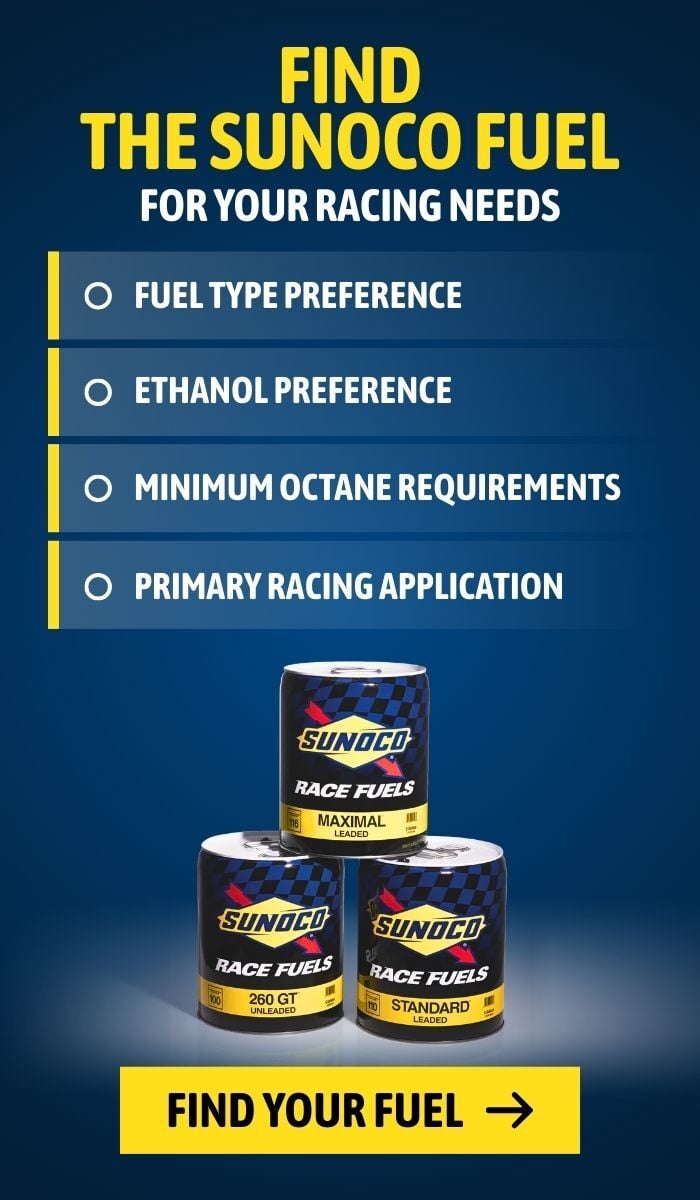
Not sure which is right for you? Use the Sunoco Fuel Selector or call the technical support line at 1-800-RACE-GAS.
How Much Does 110 Octane Cost vs 100 Octane?
Typical price premium ranges from 15-25% higher than 100 octane depending on region, supplier, and purchase quantity. Where 100 octane might cost $11-13 per gallon, 110 octane typically runs $13-16 per gallon. Regional variations reflect transportation costs and local market dynamics.
Bulk purchasing reduces per-gallon costs for both octane levels. Buying 54-gallon drums instead of 5-gallon pails typically saves $1-2 per gallon, though 110 octane maintains its percentage premium over 100 octane regardless of purchase quantity.
The decision should prioritize engine requirements over cost minimization. Spending extra on 110 octane for engines that do not need it wastes resources. Conversely, trying to save money by running inadequate octane risks expensive engine damage. Professional racing teams universally prioritize adequate octane protection because the cost of fuel pales in comparison to engine replacement or repair costs.
Who Runs 110 Octane and Why
Drag Racing Applications
Drag racing creates some of the most demanding conditions for race fuel, with extreme cylinder pressures compressed into brief intense runs that test knock resistance under maximum stress.
Professional classes like Pro Stock and Pro Modified operate well beyond 110 octane territory, typically running 114-118 octane fuels or specialized blends. However, serious bracket racing, street eliminator, and index classes frequently utilize 110 octane as baseline fuel choice. Naturally aspirated combinations built to 13:1 compression or higher benefit from 110 octane's knock protection. Turbocharged and supercharged applications pushing 20-25 psi boost similarly depend on adequate octane to prevent detonation during maximum acceleration.
The specific demands of drag racing influence fuel selection beyond simple octane requirements. Between-round heat soak creates elevated underhood temperatures that challenge vapor pressure stability. Fuel systems positioned near hot exhaust components experience thermal stress that demands stable fuel formulation. Nitrous oxide combinations amplify cylinder pressures dramatically during activation, requiring substantial octane margin to prevent knock when nitrous enrichment occurs.
Consistency matters as critically as absolute octane rating for drag racing success. Fuel property consistency ensures that optimal calibration established during testing remains valid during competition. Specific gravity stability maintains accurate fuel metering. Vapor pressure control prevents hot restart problems that cost crucial reaction time at the tree.
Circle Track Racing
Circle track racing from late models through modifieds and sprint cars universally relies on 110 octane as standard fuel choice, driven by a combination of engine specifications and operating demands.
Sustained high-RPM operation under load creates thermal conditions that challenge knock resistance more severely than brief drag racing passes. Late model engines turning 8,000-9,000 RPM for hundreds of laps accumulate heat that requires substantial octane margin for safe operation. Compression ratios typically range from 12:1 to 13.5:1 depending on specific class rules and engine builder preferences. These aggressive specifications combined with extended duration under power make 110 octane minimum acceptable fuel for most applications.
Sunoco Standard has long been the go-to 110 octane choice in circle track racing, with its comprehensive additive package and 2+ year shelf life making it a dependable option for sustained, high-heat events. Racers seeking additional oxygenation benefits may also consider Sunoco EXO2, which at the same 110 octane rating delivers real-world knock resistance closer to a 112 non-oxygenated fuel due to its extreme oxygenation. Both options are available through the Sunoco fuel finder.

Heat management considerations extend beyond combustion chamber temperatures to fuel system stability. Fuel circulating through hot engine compartments during 100-200 lap feature races must maintain consistent properties despite elevated temperatures. Vapor pressure characteristics that prevent vapor lock prove critical for maintaining fuel delivery reliability. The combination of thermal stress and duration makes fuel consistency as important as absolute octane rating for circle track success.
Many regional and national circle track series establish 110 octane as maximum permitted fuel to control costs while allowing competitive engine building. This standardization creates a level playing field where teams compete on engine building and tuning skill rather than fuel budget. The widespread 110 octane adoption in circle track racing also ensures fuel availability at most tracks hosting these events, simplifying logistics for traveling competitors.
Road Racing and Time Attack
Road racing and time attack applications push engines through sustained high-load operation that combines circle track duration demands with transient throttle variations and thermal cycling that creates unique fuel requirements.
High-compression naturally aspirated builds popular in road racing often specify 12:1 to 13:1 compression ratios to maximize power within rules restrictions. Sprint races lasting 20-30 minutes under sustained load demand fuel that maintains knock resistance as temperatures climb throughout sessions. Endurance racing extending to multi-hour events creates even more demanding thermal conditions where fuel stability becomes critical for reliable operation.
Turbocharged time attack builds targeting 600-800+ horsepower from 2.0-2.5 liter engines represent extremely aggressive power density applications. These combinations frequently run 25-30 psi boost or higher, creating cylinder pressures that absolutely require 110 octane minimum for safe operation. The brief duration of time attack runs might suggest lower thermal stress, but the intensity of maximum attack laps generates heat rapidly. Cooling system capacity and intercooler efficiency become critical factors determining whether 110 octane proves adequate or whether even higher ratings become necessary.
The racing environment affects fuel requirements beyond engine specifications alone. Road courses at high elevation experience reduced atmospheric pressure that affects both engine performance and detonation tendency. Hot weather races in summer heat challenge cooling systems and elevate intake air temperatures. These environmental factors interact with engine specifications to determine optimal fuel selection, with 110 octane providing margin that compensates for varying conditions.
Engine Building Threshold
Professional engine builders develop expertise recognizing when specifications cross thresholds demanding higher octane ratings versus when conservative fuel choices prove adequate.
Compression ratios represent the most straightforward specification triggering 110 octane recommendations. Most builders specify 110 octane for naturally aspirated combinations approaching or exceeding 12:1 compression. The exact threshold varies with combustion chamber design quality, with efficient chambers featuring proper squish and quench sometimes stretching to 12.5:1 on 110 octane while less optimal designs might require it at 11.5:1. Forced induction applications generally need 110 octane when boost exceeds 18-20 psi regardless of static compression ratio.
Piston design, squish clearance, and quench characteristics interact with compression ratio to influence octane requirements. A 12:1 compression engine with properly designed pistons creating adequate squish and quench might run safely on 110 octane. An identical compression ratio with poor chamber design lacking effective quench could require 114 octane for equivalent safety margin. These nuances explain why experienced builders sometimes recommend different fuels for seemingly similar specifications.
The importance of professional consultation cannot be overstated when building engines at thresholds where fuel choice becomes critical. Engine builders specializing in particular platforms or racing disciplines maintain extensive data about what works in similar applications. Their recommendations reflect accumulated experience across hundreds of combinations, helping racers avoid both over-specification wasting money and under-specification risking engine damage. The modest investment in professional guidance pays substantial dividends through optimal specifications that balance performance, reliability, and cost.
Making the Right Choice: 110 Octane in Context
The decision between 100 and 110 octane ultimately centers on honest assessment of actual engine requirements rather than assumptions about what race fuel implies or desires to run highest available ratings. Understanding what octane rating actually measures prevents both under-specification risking engine damage and over-specification wasting resources on unnecessary knock resistance.
110 octane represents serious racing fuel for serious applications where engine specifications genuinely demand knock resistance beyond 100 octane's capabilities. The compression ratios, boost pressures, and calibration aggressiveness that require 110 octane reflect deliberate engineering choices prioritizing maximum power extraction over conservative streetability. These are not engines that accidentally ended up needing higher octane but rather combinations built specifically to exploit the performance enabled by adequate fuel quality.
The investment in 110 octane proves justified by engine protection and performance optimization when specifications actually demand it. Compression ratios approaching 13:1, boost pressures exceeding 20 psi, or timing advances that challenge even premium race fuel create scenarios where fuel cost becomes trivial compared to engine replacement costs. The peace of mind from operating with comfortable detonation margins allows aggressive driving and sustained high-load operation without constant knock concerns.
Choosing inadequate fuel to save money creates false economy that risks engine damage far exceeding fuel cost savings. Conversely, running excessive octane beyond actual needs wastes resources better allocated to more beneficial improvements. The optimal approach involves matching fuel precisely to genuine requirements, providing adequate protection without unnecessary overspecification.
Sunoco Race Fuels provides not just 110 octane fuel products but technical expertise helping racers determine whether higher octane proves necessary for their specific applications. Professional consultation combined with proper dyno testing establishes actual octane requirements based on measured knock tendency rather than guesswork. Contact the Sunoco technical team at 1-800-RACE-GAS or use the Fuel Selector tool to match your build to the right fuel.
For builds that push beyond even 110 octane's capabilities, ultra-high octane fuels from 112-118 octane provide the knock resistance extreme applications demand. These specialized racing fuels serve professional competition and aggressive engine combinations where standard race fuel ratings prove inadequate. Understanding when to step up from 110 to even higher octane levels marks another threshold in the progression toward maximum performance extraction from racing engines operating at the absolute limits of mechanical and thermal stress.