.svg)


Are Octane Boosters Worth It? How They Work and When Race Fuel Makes More Sense
An engine needs more octane when its current fuel cannot resist knock under the conditions in which it operates. But the question comes from two very different places. Some racers are chasing a problem: pinging, sluggishness, inconsistency between events. Others are chasing performance: they want to know whether better fuel could unlock more power from a build that feels like it has more to give. Both are legitimate questions and the answer to each is different.
The right starting point is "what is preventing my engine from performing safely and consistently, and is inadequate knock resistance genuinely the cause?" This prevents the common mistake of reaching for a higher-octane fuel to mask a problem that a different fix would solve more directly. The Fuel Selector can help narrow the right fuel once the engine's actual requirements are clear.
Quick Diagnostic: Does Your Engine Need More Octane?
|
What You Notice |
Possible Fuel-Related Cause |
Recommended Next Step |
|
Audible pinging or knock under load |
Insufficient knock resistance |
Stop aggressive operation and evaluate fuel requirements and calibration |
|
ECU repeatedly pulls ignition timing |
Current fuel may be limiting ignition strategy |
Review data logs with a qualified tuner |
|
Power drops as engine temperature rises |
Reduced detonation margin under heat |
Evaluate intake temperatures, cooling system, and fuel requirements |
|
Increased compression ratio |
Higher cylinder pressure and temperature |
Recalculate fuel requirements before aggressive operation |
|
Increased boost pressure |
Greater cylinder pressure and knock tendency |
Confirm octane requirements and fuel system capacity |
|
Added nitrous oxide |
Rapid increase in oxygen and cylinder pressure |
Follow engine builder and tuner fuel recommendations |
|
Inconsistent performance between fills |
Variation in fuel properties |
Consider a purpose-built race fuel with controlled composition |
|
No knock and optimized calibration |
Additional octane may not provide benefit |
Continue monitoring rather than switching fuels |
Will Higher Octane Make My Race Car Faster?
Sometimes yes. Sometimes no. The difference comes down to one question: is your engine currently being held back by its fuel?
If the answer is yes, switching to a higher-octane or better-formulated race fuel and retuning around it can produce real, measurable performance gains. A bracket racer whose ECU has been quietly pulling 4 degrees of timing all season to protect against knock on pump premium may pick up a meaningful improvement in elapsed time after switching to a consistent 100 octane race fuel and letting the tuner restore that timing. The power was always there. The fuel was the ceiling.
If the answer is no, the engine is already operating within the capability of its current fuel with no knock activity, no timing correction, and a well-optimized calibration, then pouring a higher-octane fuel in the tank produces nothing. The additional knock resistance goes unused. The ET does not change. The only thing that changes is the fuel bill.
This is the part that most fuel marketing glosses over. Higher octane does not add power on its own. What it does is raise the ceiling on what a tuner can safely do with timing, boost, and compression. When the engine has been calibrated to take advantage of that ceiling, the power gain is real. When it has not, there is nothing to gain.
The two scenarios where switching fuel genuinely makes racers faster:
Scenario one: the fuel-limited engine. The engine has more hardware potential than the current fuel allows the tuner to use safely. The ECU is pulling timing. The boost target has been left conservative because the fuel starts knocking before optimal settings are reached. A tuner who wants to advance timing or raise boost cannot do it safely on pump gas. Switching to a race fuel with adequate knock resistance, and retuning to take advantage of it, directly translates to more power at the wheels and faster times. This is not a theory. It is the most common reason racers switch fuels and feel an immediate difference on the dyno and at the track.
Scenario two: the inconsistency problem. The engine feels right at one event and off at the next without anything mechanical changing. Lap times or ETs vary in ways that chassis and setup adjustments cannot explain. In many cases this is a fuel consistency problem. Pump gas varies in specific gravity, and vapor pressure by region and season. A calibration dialed in on last month's pump fill is running on different chemistry this month. Switching to a purpose-built race fuel with controlled, batch-consistent properties removes that variable entirely. The engine performs the same way every time it fires, which means every setup change made during the season reflects the actual chassis and mechanical variables rather than fuel noise. Consistency at the track starts with consistency in the tank.
For any racer whose current fuel is not the limiting factor, the path to faster times runs through chassis setup, driver development, and mechanical optimization, not the fuel drum. Knowing which situation you are actually in is the most valuable thing to figure out before spending anything on fuel.

Signs Your Engine May Need Higher Octane Fuel
- Audible pinging, knocking, or detonation under load. Light knock sounds like metallic pinging or rattling during hard acceleration, high-load pulls, or wide-open throttle. Severe detonation can occur so quickly and under conditions so loud that the driver does not detect it before damage has already happened. What is occurring inside the combustion chamber is the air-to-fuel mixture autoigniting ahead of the flame front initiated by the spark plug, creating uncontrolled pressure waves that stress pistons, ring lands, head gaskets, and bearings with each event. Audible knock is a warning that requires diagnosis, not a signal to immediately reach for higher-octane fuel, because other causes produce identical sounds.
- The ECU is pulling ignition timing. This is the most common sign that goes unnoticed. Knock sensors detect vibration patterns associated with abnormal combustion and the engine management system responds by retarding timing, reducing boost, or limiting torque output before the driver hears anything unusual. The engine sacrifices power to protect itself. A car that feels sluggish under hard acceleration, loses power progressively through a session, or pulls timing consistently in data logs may be running on a fuel whose knock resistance is no longer adequate for its current state of tune. As fueleconomy.gov's octane explainer notes, many modern engines adjust spark timing to reduce knock, but power suffers in the process regardless of whether the driver notices it.
- Power drops as temperatures rise. An engine that performs well when cold but degrades through a session or event is often encountering heat-related knock. Higher intake air temperatures and rising coolant and cylinder head temperatures reduce the detonation margin available for a given octane level. The ECU responds by pulling timing or reducing boost. Heat soak during staging, between rounds, or across a long race day compounds the problem. This is a situation where adequate intercooling and cooling system performance need to be evaluated first before assuming a fuel change is the answer.
- Compression ratio has been increased. Raising compression increases cylinder pressure and temperature before ignition, which directly increases knock tendency. More knock resistance is generally required as compression climbs, though the exact requirement depends on combustion chamber design, head material, quench clearance, camshaft timing, and cooling efficiency. There is no universal compression-to-octane chart that applies across all engine combinations. Engine builder recommendations and dyno validation provide the only reliable guidance for a specific build.
- Boost pressure has been increased. Forced induction raises the mass of air entering the cylinders, increasing cylinder pressure and the potential for knock at a given octane level. Each meaningful boost increase needs to be evaluated against the current fuel's knock resistance, the calibration's timing map, and the intercooler's ability to manage charge temperatures. A fuel that safely supported 15 psi may not adequately protect the same engine at 20 psi with timing that has been advanced to take advantage of the additional airflow. The relationship between boost and octane requirement is covered in more depth in how fuel selection affects tuning headroom.
- Nitrous oxide has been added. N2O increases the oxygen available during combustion and can dramatically increase cylinder pressure at activation. A fuel that safely supported the engine before the bottle was added may not provide sufficient knock resistance under a meaningful shot. Larger shots increase the demand further. Timing recommendations change, fuel delivery requirements change, and the minimum octane requirement typically increases. The full picture of how N2O changes octane requirements by shot size is worth understanding before selecting a fuel for any nitrous application.
- The tuner cannot safely advance timing or increase boost. When a tuner identifies additional power that the hardware is capable of producing but cannot reach because the current fuel begins knocking before those settings are safe, the engine is fuel-limited. This is one of the clearest and most objective indicators that a fuel change is warranted. It means the limitation has been identified through controlled testing rather than symptom guessing. Any fuel change should be followed by a full recalibration session, not a simple swap with the same tune.
- Performance is inconsistent between fills. An engine that feels right on one tank and noticeably off on the next without any mechanical changes may be responding to variation in the fuel itself. Pump E85 legally ranges from 51% to 83% ethanol by season and region. Pump premium varies in ethanol content and specific gravity by regional supplier and time of year. A calibration built for one set of fuel properties will not perform identically when those properties shift. Sunoco's Double Distilled process produces every fuel to strict batch tolerances precisely to eliminate this source of variation. If an engine is performing inconsistently and nothing mechanical has changed, the fuel is the first thing to evaluate.
Frequently Asked Questions About Octane Requirements
How do I know if my car needs higher octane fuel?
The most reliable indicators are data logs showing repeated timing correction, a tuner who cannot safely reach desired boost or timing targets on the current fuel, engine modifications that have increased compression or boost beyond what the previous fuel was selected for, and inconsistent performance that tracks with fuel source changes. Audible knock is also an indicator but is less reliable than data in modern engines with active knock management.
What happens if octane is too low?
Insufficient knock resistance causes the air-to-fuel mixture to autoignite before the spark plug fires in a controlled manner. The resulting uncontrolled pressure waves stress pistons, ring lands, head gaskets, and bearings. The engine management system may reduce timing and boost to limit damage, which reduces power. In severe cases, detonation causes mechanical damage quickly. In milder cases, the engine quietly underperforms while the knock control system does its job in the background.
Will my check engine light come on if I need higher octane?
Some vehicles trigger fault codes related to knock events, misfires, or fuel trim corrections, but many engines reduce power and pull timing without illuminating any warning. A car can be meaningfully affected by inadequate octane and show no dashboard indication at all. Data logging is more reliable than waiting for a warning light.
Can I hear detonation?
Sometimes. Light knock under moderate load can produce an audible metallic pinging. But severe detonation during a race pass or at high RPM under wide-open throttle often occurs in conditions too loud and too brief for the driver to detect it before damage occurs. Modern ECUs also intervene before audible knock develops in many applications. Relying on your ears is not a substitute for data.
Does adding boost mean I automatically need race fuel?
Not automatically, but it increases the likelihood. The relationship between boost and octane requirement depends on the base compression ratio, the intercooler's effectiveness, the calibration's timing strategy, and the operating temperature environment. A modest boost increase on a conservatively tuned engine with good charge cooling may stay within the capability of the current fuel. A significant increase on an already aggressive tune almost certainly does not.
Can I use higher octane instead of retuning?
Higher octane cannot correct an unsafe or incorrect calibration. An engine running too much timing for its current fuel will produce knock regardless of whether you step up from 100 to 110 octane if the timing was already excessive for 110. Fuel and calibration are matched to each other. Changing one without evaluating the other addresses only half the system.
Can too much octane hurt my engine?
Using more octane than an engine needs does not typically cause damage in a properly operating engine, but it provides no performance benefit and increases cost. The goal is matching octane to what the engine actually requires, not maximizing the number on the drum.

When Higher Octane Is Not the Solution
This is the section most content on this topic skips. Not every symptom that looks like an octane problem is one, and adding octane to an engine with a different underlying issue wastes money without solving anything.
An incorrect air-to-fuel ratio. A lean mixture increases combustion temperatures and knock tendency regardless of octane level. A rich mixture reduces power and creates drivability issues. Fuel delivery and calibration problems need to be corrected directly.
A failing fuel system. A weak pump, restricted filter, undersized injectors, or degraded fuel lines can create lean conditions under load that higher octane cannot compensate for. Fuel pressure and injector data logs identify this before it causes damage.
Inadequate intercooling or high intake temperatures. If intake air temperatures are elevated because the intercooler is undersized, the core is heat-soaked, or ambient conditions are extreme, correcting those conditions is more effective than increasing octane. Higher octane raises the knock threshold but does not reduce the temperature of the air entering the engine.
Ignition system problems. Incorrect spark plugs, weak coils, excessive plug gap, or deteriorated ignition wires can cause misfires and power loss that is easily mistaken for fuel-related knock. These should be ruled out before fuel is blamed.
Mechanical damage or carbon deposits. Carbon buildup creates hot spots that increase knock tendency independently of octane level. Low compression, damaged valves, worn rings, or head gasket failure require mechanical repair. An engine with these issues will knock on any fuel until the root cause is corrected.
An incorrect calibration. Excessive ignition advance, improper boost control, or incorrect fuel delivery can produce knock even when the octane is adequate. Higher octane should never be used to compensate for a tune that was unsafe in the first place.
Do You Need More Octane or a Different Fuel Formulation?
Octane rating is one specification among several. Two fuels at the same octane level can differ meaningfully in oxygen content, specific gravity, ethanol content, vapor pressure, and burn characteristics. An engine that is experiencing limitations may need a different formulation rather than simply more octane, and some formulations provide real-world detonation resistance that exceeds what their stated octane implies.
|
Engine Situation |
Fuel Consideration |
|
Mild performance engine knocking on pump premium |
Evaluate whether 95 or 100 octane provides adequate protection |
|
Street/strip or track-day car with moderate compression or boost |
Consider an unleaded race fuel compatible with the vehicle's emissions equipment |
|
Dedicated high-compression race engine |
Evaluate 110 octane or higher based on engine builder recommendations |
|
Aggressive forced-induction application |
Consider octane, charge cooling, oxygen content, and fuel system requirements together |
|
Turbocharged engine on pump E85 with inconsistent behavior |
Evaluate whether controlled race E85 improves consistency and tuning repeatability |
|
Engine using nitrous oxide |
Select fuel based on compression ratio, shot size, timing strategy, and system recommendations |
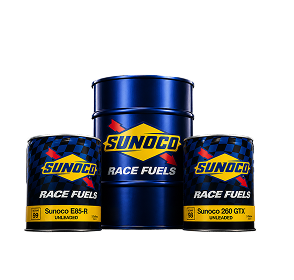
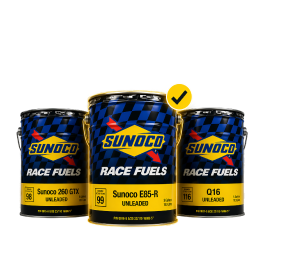
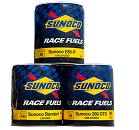
Sunoco 260 GT at 100 octane is a practical starting point for street/strip, track-day, and moderate forced-induction applications that have moved past pump premium. Unleaded and compatible with oxygen sensors and catalytic converters, it delivers consistent fuel chemistry where pump gas cannot. Sunoco Standard at 110 octane is the workhorse of dedicated racing applications across virtually every discipline, leaded and non-oxygenated, covering most naturally aspirated and moderate-to-high boost builds. Sunoco EXO2 illustrates why octane alone does not tell the full story: at 110 octane it is highly oxygenated, and its real-world detonation resistance exceeds its stated rating in properly tuned applications, making it a different tool than Standard despite sharing the same number. For turbocharged builds where ethanol is permitted and the fuel system supports it, Sunoco E85-R provides the consistent 85% ethanol content that pump E85 cannot guarantee.
Builds that have moved into the 110 to 118 octane range will find the right option in Sunoco's high-octane race fuel lineup.
How to Evaluate Your Engine's Actual Octane Requirement
Start with the engine builder's or tuner's minimum fuel recommendation rather than guessing from horsepower alone. Then document the complete combination: static compression ratio, boost pressure and type of forced induction, nitrous use and shot size, current ignition timing map, intake air and coolant temperatures under race conditions, and fuel system capacity.
Review available data before making a fuel change. Knock activity, timing correction, air-to-fuel ratio, fuel pressure, injector duty cycle, and boost pressure under representative operating conditions all provide more reliable evidence than symptoms alone. An engine that appears safe during a short street pull may behave differently during sustained competition where heat builds and operating conditions push the limits the fuel was chosen for.
Increase octane only when the data and the engine combination justify it. Use enough to provide adequate knock protection and a reasonable tuning margin. Avoid assuming that unnecessary octane improves reliability or performance, because it does not.
The Fuel Selector works through compression ratio, boost, application, and other parameters to return a specific recommendation. For builds that require more context than a selector tool provides, Sunoco's technical team at 1-800-RACE-GAS handles those conversations directly. The Fuel Finder locates dealers near any track, and most fuels in the lineup are available to order online for programs that prefer to have fuel secured before arriving at the venue.