
How Much Horsepower Does Race Fuel Add?
The LS, the Coyote, and the 2JZ are three of the most popular engines to put under boost, and each one asks something a little different of its fuel. For any of them, the right race fuel comes down to how hard the engine is pushed and what its fuel system and emissions hardware can handle. Street-driven builds that keep their oxygen sensors and catalytic converters do best on unleaded fuels such as Sunoco 260 GT, a 100 octane unleaded fuel, Sunoco Evo 10, or Sunoco E30-R. Builds with a fuel system sized for ethanol can step up to Sunoco E85-R or Sunoco EPX, and Sunoco lists GM's LS series, Ford's Coyote, and Toyota's 2JZ by name as target engines for EPX. Race-only engines with no catalytic converters can also run leaded fuels such as Sunoco Standard, a 110 octane leaded fuel, or Sunoco MaxNOS.
Each of these engine families pushes the fuel decision in its own direction. The turbo LS is often built on an iron-block truck engine and pointed at the drag strip. The Coyote carries high factory compression and, in later generations, direct injection. The 2JZ was designed from the factory to take boost. This guide covers how those differences shape fuel choice and which Sunoco race fuels fit each platform at different levels of boost and fuel system capacity.
What Determines the Best Race Fuel for a Boosted Engine?
The best race fuel for a boosted engine is the one with enough knock resistance for the engine's boost, compression, and ignition timing, delivered in a form the fuel system can supply and the car's hardware can tolerate. Octane is a fuel's measured resistance to detonation. Detonation is the uncontrolled ignition of the remaining air-fuel mixture after the spark plug fires, and in a turbocharged or supercharged engine it can break ring lands and damage pistons quickly. Boost raises cylinder pressure and charge temperature, so the octane requirement climbs with every pound of boost and every degree of added timing. Sunoco's page on understanding octane ratings explains how those ratings are measured.
Fuel system capacity is the second limit. Many of the strongest boost fuels are oxygenates, meaning fuels that carry oxygen in their molecules, such as ethanol. An oxygenated fuel has a lower stoichiometric ratio, which is the chemically correct ratio of air to fuel for complete combustion. Gasoline sits near 14.7:1. Sunoco E30-R lists a stoichiometric ratio of 12.9, E85-R lists 9.8, and EPX lists 9.4. The lower that number, the more fuel the injectors and pump have to move for the same amount of air.

Emissions hardware and class rules set the last boundary. Leaded fuel damages catalytic converters and contaminates oxygen sensors, so any car that keeps that equipment needs an unleaded fuel. Sunoco's comparison of leaded vs. unleaded race fuels covers the trade-offs in detail, and the Sunoco guide to fuel for turbocharged and supercharged cars covers boosted fueling strategy in general terms.
What Is the Best Race Fuel for a Turbo LS?
The best race fuel for a turbo LS is Sunoco E85-R or EPX when the fuel system is built for ethanol, Sunoco Evo 10 or 260 GT for street-driven builds on a gasoline fuel system, and Sunoco Standard, Supreme, or MaxNOS for race-only engines that can run leaded fuel. GM's LS family is a pushrod V8 that uses port fuel injection in its Gen III and Gen IV forms, and many turbo LS builds start from an iron-block truck engine. That combination of displacement and boost puts heavy demands on fuel volume, which is often the factor that decides between gasoline and ethanol.
Street-Driven Turbo LS Builds
A turbo LS that still sees street miles and runs catalytic converters needs an unleaded fuel. Sunoco 260 GT is a 100 octane unleaded fuel with 9.8% ethanol, and Sunoco states it allows more boost than lower octane pump gas without harming catalytic converters or oxygen sensors. In California and other areas that require CARB-compliant fuel, Sunoco SS 100 is the street-legal 100 octane option, since 260 GT is not street legal there.
For more knock resistance without new injectors, Sunoco Evo 10 is a 105 octane unleaded fuel with 11% ethanol. A Sunoco technical specialist writing for the Sports Car Club of America described Evo 10 as the most extreme fuel Sunoco offers that will work with stock fuel systems, noting that it needs about 6% more fuel volume than pump gas and tends to want less ignition timing because of its fast burn rate. That article also notes Evo 10 lowers intake air temperatures on port-injected engines, which is how the LS is fueled. Evo 10 is labeled for off-road and racing use only.
Turbo LS on Ethanol
An LS with injectors and a pump sized for ethanol can take full advantage of Sunoco E85-R. E85-R is an unleaded fuel blended to a constant 85% ethanol, with an octane rating of 99 that Sunoco lists as an estimate because standard ASTM laboratory octane tests cannot accommodate its oxygen content. For builds that have outgrown E85-R, Sunoco EPX carries 34% oxygen by weight compared with 30% for E85-R. EPX has no conventional octane rating for the same reason, and Sunoco states that in real-world use it protects engines running up to 30 psi of boost. Sunoco's article on the best E85 race fuel covers the fuel system changes that a switch to E85 requires.
Race-Only Turbo LS Builds
A dedicated drag or race LS with no catalytic converters can use leaded fuel. Sunoco Standard is designed for compression ratios up to about 13:1 in conventional V8s with iron cylinder heads, and Sunoco calls it a good choice for mild nitrous, turbocharged, and supercharged applications. Sunoco Supreme, a 112 octane leaded fuel, adds margin for higher compression and higher rpm. At the top of the boost range, Sunoco MaxNOS is a 116 octane leaded fuel built for power adders, and Sunoco tested it in drag applications ranging from high-boost turbocharged engines to multi-stage nitrous combinations. Because lead contaminates oxygen sensors, leaded fuel belongs in race-only engines whose owner and tuner have planned around that limitation.
What Is the Best Race Fuel for a Boosted Coyote?
The best race fuel for a boosted Coyote is Sunoco E30-R or Evo 10 for builds on a stock or lightly upgraded fuel system, and Sunoco E85-R or EPX for builds with an ethanol-capable fuel system. Ford's Coyote is a 5.0L DOHC V8 that runs high factory compression for an engine that so often gets boosted, which leaves less room for detonation than a low-compression turbo engine. Gen 3 and later Coyotes also pair direct injection with port injection, and that fuel system shapes how much ethanol a build can support before it needs upgrades.
Unleaded Fuels for Street and Track Coyotes
Many boosted Coyotes are street and track day cars that keep their oxygen sensors and catalytic converters, which points them toward unleaded fuels. Sunoco E30-R is a 99 octane unleaded fuel certified to contain 30% ethanol in every batch, and Sunoco lists it for highly boosted engines and modern engines with oxygen sensors. Sunoco's article on ethanol blends in racing fuels explains why a fixed 30% blend can serve as a middle step between pump gas and full E85.
Evo 10 is the other strong fit. The SCCA article from Sunoco notes that Evo 10 reduces combustion chamber temperatures on direct-injected engines, which applies directly to Gen 3 and later Coyotes. Sunoco 260 GT Plus, a 104 octane unleaded fuel with 13% ethanol, sits between 260 GT and Evo 10 and also requires more fuel flow than a non-oxygenated fuel. Evo 10 and 260 GT Plus both contain MMT (methylcyclopentadienyl manganese tricarbonyl), a manganese-based octane booster that sunlight breaks down, so those pails need to stay out of direct light.
E85-R and EPX for Coyotes With Upgraded Fuel Systems
Once a Coyote has the injectors and pump capacity for full ethanol, E85-R and EPX become the high-boost options. Sunoco names Ford's Coyote and Modular engines among the domestic V8s running big turbos and superchargers that EPX was built for. E85-R is the starting point for most of these builds, and EPX is the step for combinations that have pushed past what E85-R supports.
Coyotes in Classes That Limit Oxygenates
Some sanctioning bodies limit or ban oxygenates in certain classes. For those cars, Sunoco 260 GTX, a 98 octane unleaded fuel with no ethanol, contains no oxygenates and no metallic additives, and Sunoco states that turbocharged and supercharged race cars requiring an unleaded fuel are good candidates for it. 260 GTX is for off-road and racing use only.

What Is the Best Race Fuel for a 2JZ?
The best race fuel for a high-boost 2JZ is Sunoco EPX or E85-R on an ethanol-capable fuel system, Sunoco MaxNOS for race-only builds that can run leaded fuel, and Sunoco Evo 10 or 260 GT Plus for street-driven cars on gasoline. Toyota built the 2JZ-GTE as a 3.0L inline-six with a cast-iron, closed-deck block and dished pistons that lower compression. Low static compression gives the engine room for very high boost, and at high boost, fuel delivery often becomes the limiting factor.
Ethanol Fuels for High-Boost 2JZ Builds
Sunoco lists drag racers running highly boosted import engines, including Toyota's 2JZ, as a target application for EPX. A 2JZ built around a large single turbo and an ethanol fuel system can run E85-R as its baseline fuel and move to EPX when boost climbs. Both fuels need far more fuel volume than gasoline, so injector and pump sizing has to come first. Sunoco's guide to fuel metering for oxygenated fuels covers how to calibrate for that extra flow.
Leaded Fuel for Race-Only 2JZ Builds
A 2JZ that never sees the street and runs no catalytic converter can use leaded race gas. Sunoco MaxNOS is the closest match in the catalog, since Sunoco tested it on high-boost turbocharged small engines and lists it for nitrous, supercharged, and turbocharged applications. MaxNOS contains no ethanol, so it delivers its knock resistance without the extra fuel volume that ethanol requires. Its stated shelf life is 3 years or more in sealed, opaque containers.
Street-Driven 2JZ Builds
A 2JZ street car on a gasoline fuel system can use Evo 10 or 260 GT Plus for added octane over pump gas. Both are unleaded and safe for oxygen sensors, and both are labeled for off-road and racing use only. For a street 2JZ that has to stay legal on public roads, 260 GT outside California and SS 100 inside California are the 100 octane options.
Sunoco Race Fuels for Turbo LS, Boosted Coyote, and 2JZ Builds
The table below lists the Sunoco race fuels that fit these three platforms, with figures from the Sunoco Race Fuels catalog.
|
Sunoco Fuel |
Octane |
Type |
Ethanol |
Best fit across these platforms |
|---|---|---|---|---|
|
260 GT |
100 |
Unleaded |
9.8% |
Mild street builds on stock fueling outside California |
|
SS 100 |
100 |
Unleaded |
9.5% |
Street builds in California and other CARB areas |
|
E30-R |
99 |
Unleaded |
30% |
Boosted Coyotes and LS builds between pump gas and E85 |
|
260 GT Plus |
104 |
Unleaded |
13% |
Street and track builds needing more octane |
|
Evo 10 |
105 |
Unleaded |
11% |
Stock-fuel-system builds, including direct-injected Coyotes |
|
E85-R |
99 (estimated) |
Unleaded |
85% |
Ethanol-capable LS, Coyote, and 2JZ builds |
|
EPX |
Not rated (high oxygen) |
Unleaded |
85% |
High-boost LS, Coyote, and 2JZ drag builds |
|
260 GTX |
98 |
Unleaded |
0% |
Classes that limit or ban oxygenates |
|
Standard |
110 |
Leaded |
0% |
Race-only turbo LS with moderate boost |
|
Supreme |
112 |
Leaded |
0% |
Race-only builds with higher compression or rpm |
|
MaxNOS |
116 |
Leaded |
0% |
Race-only, high-boost LS and 2JZ builds |
All leaded fuels in this table, along with 260 GT Plus, Evo 10, E30-R, E85-R, EPX, and 260 GTX, are labeled by Sunoco for off-road and racing use only.
How Should You Tune When Switching Race Fuels?
Any change between fuel types calls for a tune built around the new fuel, and oxygenated fuels require the largest changes. Sunoco's E85 article notes that E85 typically needs about 30% to 40% more fuel volume than gasoline at the same power level, while Evo 10 needs about 6% more. Running an oxygenated fuel on a calibration built for gasoline leads to a lean condition, which raises combustion temperature and invites detonation.
Specific gravity, which is a fuel's density relative to water, also affects fuel delivery, since it changes how much fuel mass a given injector pulse delivers. Sunoco's article on why specific gravity matters in race fuel covers how density shifts a tune. After a fuel change, Sunoco's guides on tuning for Sunoco race fuels and reading spark plugs help confirm the engine is running where it should. Builds that add nitrous on top of boost should also review Sunoco's guide to nitrous oxide and octane requirements.
Why Does Fuel Consistency Matter More as Boost Rises?
Fuel consistency matters more as boost rises because a high-boost tune has less margin for any change in the fuel's octane, ethanol content, or density. Pump E85 is the clearest example. The U.S. Department of Energy's Alternative Fuels Data Center defines E85 as a blend containing 51% to 83% ethanol depending on geography and season, so a tune built on one fill may not match the next. E85-R, E30-R, and EPX hold a fixed ethanol content in every batch.
Sunoco produces its race fuels with a double distillation process built for batch-to-batch consistency, which keeps a calibration valid from one drum to the next. Ethanol fuels also absorb moisture over time, so Sunoco's race fuel storage guidelines call for dark, tightly sealed containers kept at stable temperatures.
Frequently Asked Questions
Can a stock fuel system run Sunoco E85-R?
Sunoco E85-R can only be used in fuel systems designed for E85 blends, because it requires far more fuel flow than gasoline. For a turbo LS, Coyote, or 2JZ on a stock or lightly upgraded system, Sunoco E30-R or Evo 10 is the better fit.
What is the difference between Sunoco E85-R and EPX?
Both are unleaded fuels with 85% ethanol, and EPX carries more oxygen. EPX contains 34% oxygen by weight compared with 30% for E85-R, with a stoichiometric ratio of 9.4 compared with 9.8. Sunoco states EPX protects engines running up to 30 psi of boost in real-world use, and neither fuel can be accurately rated with a standard ASTM octane test.
Is leaded race fuel safe for a turbo LS or 2JZ?
Leaded fuels such as Standard, Supreme, and MaxNOS work in race-only engines with no catalytic converters. Lead damages catalytic converters and contaminates oxygen sensors, and Sunoco labels its leaded fuels for off-road and racing use only.
Which Sunoco fuel suits a direct-injected Coyote?
Sunoco Evo 10 and E30-R are both unleaded and safe for oxygen sensors and catalytic converters. A Sunoco technical article notes that Evo 10 lowers combustion chamber temperatures on direct-injected engines, which applies to Gen 3 and later Coyotes.
Do I need to retune when switching between Sunoco race fuels?
A retune is required any time the oxygen content of the fuel changes. Moving from gasoline to E30-R, E85-R, or EPX changes the stoichiometric ratio and the fuel volume the engine needs, and even Evo 10 needs about 6% more fuel than pump gas.
What is the best street-legal race fuel for a boosted car in California?
Sunoco SS 100 is the CARB-compliant 100 octane unleaded fuel for California street use. Outside California, Sunoco 260 GT is the 100 octane unleaded option.
Finding the Right Fuel for Your Build
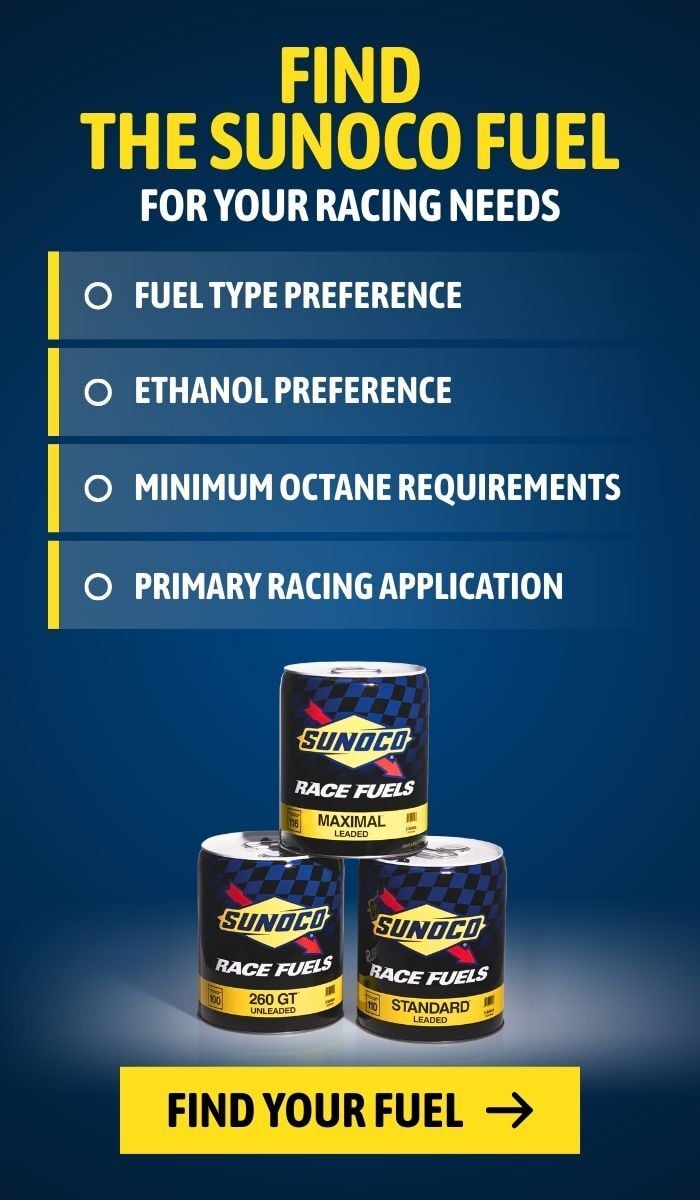
Every turbo LS, Coyote, and 2JZ combination is different, and the Sunoco Fuel Selector works through octane needs, ethanol preference, and application to recommend a specific product. Builds that sit outside the standard guidelines can go to Sunoco's technical team at 1-800-RACE-GAS or through the Sunoco Race Fuels contact page.
Once the fuel is chosen, the Fuel Finder shows local dealers, including fuel-specific searches such as dealers carrying Sunoco EPX. Racers who would rather have pails or drums shipped can buy Sunoco race fuel online.