.svg)



AV Fuel in Race Engines: Why It's Not the Solution Many Think It Is
ETHANOL'S EXPANDING ROLE IN MODERN RACING
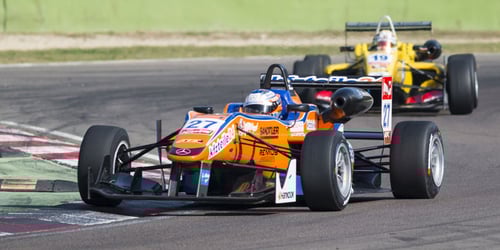
Ethanol has become one of the most influential components in modern racing fuel technology. Once seen primarily as a renewable energy source for passenger vehicles, ethanol now plays a vital role in motorsports, where it contributes to increased power output, enhanced cooling properties, and reduced emissions. As race engines become more advanced with higher compression ratios, forced induction systems, and greater demands for consistent performance under extreme conditions, ethanol blends are increasingly at the forefront of racing innovation.
The evolution of ethanol in racing reflects broader changes in fuel chemistry and engine technology. Ethanol contains oxygen in its molecular structure, which allows it to burn more completely than traditional hydrocarbons. This oxygenated fuel characteristic provides racers with tangible performance benefits: better throttle response, higher octane ratings, and superior resistance to detonation, all critical factors when engines are pushed to their limits lap after lap.
Modern racing sanctions across multiple disciplines have embraced ethanol-blended fuels, recognizing both their performance advantages and environmental benefits. From NASCAR's switch to E15 (15% ethanol) in 2011 to IndyCar's use of E85 (up to 85% ethanol), professional racing has validated ethanol's capability to deliver championship-winning performance while supporting sustainability initiatives. According to the U.S. Department of Energy, ethanol's high octane rating and domestic production make it an increasingly attractive fuel component for high-performance applications.
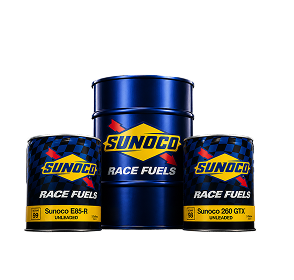
Sunoco Race Fuels has been developing race fuels for decades, working as the official fuel supplier to major racing series including NASCAR, NHRA, and numerous grassroots racing organizations. The company combines fuel chemistry expertise with rigorous quality control to create ethanol-based fuels, including popular options like E85-R, E30-R, and EVO 10, designed with precision and consistency to give competitors reliable performance, from weekend racers to professional teams.
THE SCIENCE BEHIND ETHANOL IN RACING FUELS
To understand why ethanol has become a powerhouse in modern race fuels, it's important to look at the chemistry behind it. At the molecular level, ethanol (C₂H₅OH) differs fundamentally from hydrocarbon-based gasoline. Ethanol molecules contain oxygen, approximately 35% by weight, which helps enrich the air-fuel mixture during combustion. This oxygenation leads to a more complete burn, improving thermal efficiency and reducing unburned hydrocarbons that would otherwise exit through the exhaust as wasted energy and emissions.
This cleaner, more complete combustion process means racers can extract more usable energy from each gallon of fuel. The oxygen within ethanol effectively acts as an internal oxidizer, allowing the fuel to burn more thoroughly even in fuel-rich conditions that high-performance engines often require. This characteristic becomes especially valuable in power-adder applications where fuel volume must increase dramatically to support additional air from turbochargers or superchargers.
ETHANOL'S COOLING PROPERTIES
Beyond its oxygen content, ethanol also has a significant cooling effect that provides measurable performance advantages. When it vaporizes in the intake system, ethanol absorbs substantially more heat than gasoline, approximately 2-3 times more due to its higher heat of vaporization (approximately 904 BTU/lb for ethanol versus 150 BTU/lb for gasoline). This process lowers the temperature of the intake charge considerably, often by 30-50°F depending on the ethanol concentration and engine configuration. Cooler air means denser oxygen molecules per cubic inch of cylinder volume, which translates directly into more power potential without requiring any mechanical modifications.
In turbocharged applications, where compressed air naturally increases in temperature, ethanol's evaporative cooling helps counteract heat buildup, allowing teams to run higher boost pressures more safely than would be possible with straight gasoline.
DETONATION RESISTANCE AND OCTANE RATING
Another major advantage of ethanol is its exceptional resistance to detonation, the uncontrolled combustion event that can occur when fuel ignites prematurely under high cylinder pressures and temperatures. High-performance engines operate under extreme conditions where pre-ignition or knocking can destroy pistons, ring lands, and bearings in seconds. Ethanol's high octane rating ranging from approximately 100 octane for E10 blends up to 113 octane for E85 formulations allows racers to push engines harder, using more boost pressure and ignition timing advance without the risk of damaging detonation.
These scientific properties are precisely why Sunoco's engineers have developed purpose-built ethanol blends like E30-R and E85-R to capture ethanol's full performance benefits while maintaining stability, predictability, and power consistency. Unlike pump E85, which can vary significantly in ethanol content (anywhere from 51% to 83% ethanol depending on season and location), Sunoco's racing ethanol blends maintain tight specifications year-round. E85-R, for instance, consistently delivers 85% ethanol content with carefully selected hydrocarbon components, ensuring that tuners can dial in their engine calibrations with confidence and achieve repeatable results from track to track.
SUNOCO E30-R: CONSISTENCY MEETS PERFORMANCE
For racers seeking a controlled and repeatable ethanol blend that bridges the gap between pump gas and high-concentration ethanol fuels, Sunoco E30-R offers the perfect balance. Designed specifically for modern turbocharged and supercharged engines as well as naturally aspirated builds seeking enhanced knock resistance, E30-R contains precisely 30% ethanol blended with high-quality hydrocarbons selected for their performance characteristics and stability. This carefully engineered ratio provides ethanol's cooling and anti-detonation advantages while maintaining fuel system compatibility and consistent performance across different setups, climates, and operating conditions.
THE E30 SWEET SPOT
The 30% ethanol concentration represents a strategic "sweet spot" in racing fuel design. It delivers measurable performance gains including increased octane rating (approximately 94-96 AKI), improved charge cooling, and enhanced throttle response, without requiring the extensive fuel system modifications that higher ethanol concentrations demand. Most fuel pumps, injectors, and fuel lines designed for gasoline can handle E30-R effectively, making it an accessible performance upgrade for racers transitioning from pump gas or lower-octane race fuels.
Unlike pump fuels labeled "E30" or DIY ethanol mixtures created by blending pump E85 with gasoline, E30-R eliminates uncertainty and variability, two factors that have no place in competitive racing. Racers often mix their own ethanol blends at the track or in their shop to achieve specific ethanol percentages, which introduces variability that can throw off carefully calibrated air/fuel ratios, cause dangerous lean conditions, and ultimately impact both performance and reliability. Pump E85 content can vary from 51% to 83% depending on seasonal blending and geographic location, making consistent mixing nearly impossible without laboratory testing of each batch.
ENGINEERED CONSISTENCY
Sunoco's E30-R is engineered to remove that guesswork entirely. Every batch is precision-blended to the same specifications and undergoes rigorous quality control testing before it reaches racers. This means identical octane ratings, identical cooling properties, and identical combustion characteristics from drum to drum, coast to coast, and race to race. When a tuner develops an engine calibration for E30-R, that tune will perform exactly the same whether the fuel was purchased in California or Florida, in January or July.
This consistency is particularly valuable for racers using flex-fuel systems, aftermarket ECUs, or standalone engine management systems that allow detailed tuning for ethanol-based power. With E30-R, tuners can optimize ignition timing, boost pressure, and fuel delivery with confidence, knowing the fuel will behave predictably under all conditions. The result is maximum power output with maximum safety margins, a combination that wins races and protects expensive engine components.
E30-R is also an excellent choice for sportsman racers, club racing competitors, and street/strip enthusiasts who want to experience ethanol's performance benefits without committing to the more aggressive fuel system requirements of E85. It provides a noticeable power increase over premium pump gas (typically 5-10% depending on the application and tuning), improved engine protection under boost, and the peace of mind that comes from using a professionally engineered racing fuel.
E85-R: THE STANDARD FOR HIGH ETHANOL RACE FUELS
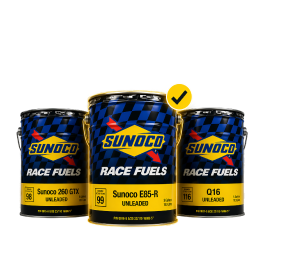
When it comes to high-ethanol race fuels, Sunoco E85-R has become the benchmark that serious competitors measure all others against. Containing precisely 85% ethanol and 15% high-quality hydrocarbons carefully selected for their combustion characteristics and stability, E85-R is designed for maximum power in applications that can fully utilize high ethanol content from all-out drag racing combinations to road racing endurance engines and everything in between.
SUBSTANTIAL PERFORMANCE ADVANTAGES
The performance advantages of E85-R are substantial and measurable. With an octane rating approaching 113, it provides exceptional knock resistance that allows engine builders to run aggressive calibrations that would be impossible with gasoline-based fuels. Turbocharged engines can safely operate at boost levels 5-10 psi higher than with premium pump gas. Naturally aspirated builds can run compression ratios well into the 13:1 to 15:1 range without detonation concerns. The result is dramatic power increases 10-15% or more compared to premium gasoline while actually improving engine safety margins.
THE PUMP E85 PROBLEM
One of the biggest challenges with pump E85, and the primary reason it's unsuitable for serious racing applications, is its inherent variability. Depending on the region, season, and even individual gas stations, pump E85 can contain anywhere from 51% to 85% ethanol, a massive 34-percentage-point swing that makes consistent tuning difficult if not impossible.
This fluctuation in ethanol content directly affects stoichiometric air-fuel ratio, octane rating, energy content, and cooling properties which are all critical parameters that tuners must account for when calibrating modern fuel-injected engines. A car tuned for true 85% ethanol content running on 51% ethanol fuel could experience dangerous lean conditions and detonation. Conversely, a conservative tune designed for lower ethanol content will leave significant power on the table when actual ethanol concentration is higher.
SUNOCO'S SOLUTION: PRECISION BLENDING
Sunoco's E85-R eliminates that issue entirely. Each batch is blended to precise specifications under controlled conditions and undergoes extensive quality testing to verify ethanol content, octane rating, and chemical composition. This ensures consistent 85% ethanol content and stable performance characteristics every time, whether you're filling up in Texas in July or Michigan in January. The hydrocarbon portion is also carefully formulated to complement ethanol's characteristics and provide optimal vaporization and combustion properties.
E85-R's composition allows for exceptional knock resistance, dramatically cooler combustion temperatures (often 100°F or more reduction in exhaust gas temperatures compared to gasoline), and the ability to support extremely high boost pressures or compression ratios that push the boundaries of internal combustion performance. The cooler-running characteristics also extend engine component life, allowing pistons, valves, and turbine wheels to survive conditions that would quickly destroy them on gasoline.
Championship-winning teams rely on E85-R because they know that fuel variability can cost races, or worse, engines. Sunoco's commitment to consistency eliminates that variable from the performance equation. For insights into how sustainable fuels are shaping racing's future, read our article on the future of racing fuels: innovation and sustainability.
TUNING CONSIDERATIONS FOR ETHANOL BLENDS
Switching to ethanol blends like E30-R or E85-R requires careful tuning and a thorough understanding of how ethanol's chemical properties affect engine calibration. While the performance benefits are substantial, realizing them safely demands attention to fuel system capacity, air/fuel ratio targets, and ignition timing strategy.
UNDERSTANDING STOICHIOMETRIC RATIOS
Ethanol contains oxygen within its molecular structure, meaning the stoichiometric air/fuel ratio (or the chemically ideal mixture for complete combustion) differs significantly from that of pure gasoline. Gasoline burns at a stoichiometric ratio of approximately 14.7:1 (air to fuel), while pure ethanol's stoichiometric ratio is approximately 9.0:1. For E85 blends like E85-R, the stoichiometric ratio sits around 9.8:1, and for E30 blends like E30-R, it's approximately 12.5:1 to 13:1.
This means tuners must adjust fuel delivery significantly to account for the increased oxygen content and higher fuel volume requirements. An engine calibrated for gasoline that switches to E85-R without tuning adjustments will run dangerously lean potentially by 30-40% or more because the engine management system is still delivering fuel based on gasoline's stoichiometric ratio. Modern wideband oxygen sensors and air/fuel ratio monitors are essential tools for ensuring proper mixture throughout the RPM range.
FUEL SYSTEM REQUIREMENTS
Ethanol also has lower energy content per gallon compared to gasoline, approximately 76,000 BTU/gallon for E85 versus 115,000 BTU/gallon for gasoline. This means engines need approximately 30-35% more fuel volume when running E85-R to produce the same power as gasoline, and proportionally more for other ethanol concentrations. E30-R typically requires about 10-12% more fuel flow than straight gasoline. To meet these demands, engines need larger fuel injectors, higher-capacity fuel pumps, and sometimes upgraded fuel lines and regulators to deliver the additional volume necessary to achieve proper air/fuel ratios under all operating conditions, from idle to wide-open throttle.
Static fuel injector sizing should account for the increased volume requirements with adequate headroom. For example, if an application requires 800cc/min injectors on gasoline, switching to E85-R would necessitate approximately 1050-1100cc/min injectors to maintain the same power level with proper air/fuel ratios. Fuel pumps must similarly be sized to deliver 30-35% more volume while maintaining appropriate pressure.
IGNITION TIMING AND BOOST OPTIMIZATION
The real power gains from ethanol come from its exceptional knock resistance and cooling properties, which allow substantially more aggressive calibrations. Ignition timing can typically be advanced 3-8 degrees compared to gasoline, depending on the application, ethanol concentration, and boost levels. Turbocharged and supercharged combinations can safely run significantly higher boost pressures (often 5-10 psi more) without encountering detonation.
However, these adjustments must be made methodically on a proper dyno or with extensive data logging using knock detection systems. Professional tuners use tools like cylinder pressure sensors, acoustic knock detection, and exhaust gas temperature monitoring to optimize calibrations safely while extracting maximum power.
THE CONSISTENCY ADVANTAGE
Precision tuning ensures that racers can extract ethanol's full benefits: more power, better cooling, and greater reliability under competitive conditions. Because Sunoco's ethanol race fuels like E30-R and E85-R are engineered for batch-to-batch consistency with tightly controlled specifications, tuners can make adjustments with complete confidence, knowing the fuel's composition won't vary from one drum to the next or between racing events.
This consistency eliminates one of the largest variables in the tuning equation. Once an optimal calibration is developed for Sunoco E85-R, that same tune will perform identically whether the fuel was purchased on the East Coast or West Coast, in spring or fall. This repeatability is invaluable for professional teams that compete across multiple venues and for sportsman racers who need their combination to perform predictably weekend after weekend.
STORAGE AND HANDLING OF ETHANOL RACING FUELS
Ethanol is hygroscopic, meaning it naturally attracts and absorbs moisture from the surrounding air. This characteristic can impact fuel stability and performance over time if not stored properly, making proper storage and handling practices essential for maintaining ethanol fuel integrity and ensuring the performance advantages you paid for remain intact when it's time to race.
THE PHASE SEPARATION CHALLENGE
When ethanol fuel absorbs excessive moisture, it can undergo phase separation, where the ethanol and water separate from the hydrocarbon components and settle to the bottom of the container as a distinct layer. This separation fundamentally changes the fuel's properties: the upper gasoline layer loses octane rating and cooling benefits, while the ethanol-water layer at the bottom can cause poor combustion, misfires, fuel system corrosion, and potentially catastrophic engine damage if it reaches the combustion chamber.
Phase separation is one of the most significant concerns with ethanol fuel storage, particularly in humid environments or when containers aren't properly sealed. That's why proper storage protocols aren't optional, they're critical for fuel performance and engine protection.
BEST PRACTICES FOR STORAGE
Sunoco recommends keeping ethanol race fuels like E30-R and E85-R in tightly sealed, approved fuel containers that minimize air exposure and prevent moisture infiltration. Drums should be stored upright in a cool, dry location away from direct sunlight, which can accelerate fuel degradation through heat and UV exposure. Ideal storage temperatures are between 50-80°F with low humidity.
When transferring fuel, work in dry conditions and minimize the time containers remain open to the atmosphere. Use dedicated equipment for ethanol fuels to prevent cross-contamination with other fuel types or water. If you're storing fuel for extended periods, consider using sealed steel drums with vapor barriers rather than plastic containers, which can allow moisture permeation over time.
For race teams storing fuel at the track or in transporters, specialized fuel jugs designed for ethanol such as those with positive-seal caps and gasket systems rated for ethanol compatibility, are worth the investment. These containers prevent the slow moisture absorption that can occur with standard fuel jugs over weeks or months of storage.
FUEL SYSTEM MATERIAL COMPATIBILITY
It's also important to ensure all fuel system components, including fuel lines, seals, gaskets, O-rings, and pump internals, are compatible with ethanol. Ethanol can degrade certain rubber compounds, cork gaskets, and some plastics that were common in older vehicles. Modern fuel systems typically use ethanol-resistant materials, but when converting older engines or race cars to ethanol, verify that all fuel-wetted components are rated for ethanol use. Look for materials like fluorocarbon elastomers (Viton), PTFE (Teflon), and ethanol-rated nylon or reinforced rubber.
SHELF LIFE RECOMMENDATIONS
When stored properly in sealed containers in appropriate conditions, Sunoco ethanol race fuels maintain their performance characteristics for approximately 6-12 months, significantly longer than pump E85. However, for maximum performance and peace of mind, many professional teams prefer to use fuel within 3-6 months of purchase and rotate stock regularly during the racing season.
HARNESS THE POWER OF ETHANOL WITH SUNOCO
Ethanol has fundamentally changed the game in racing, transforming from an alternative fuel curiosity into a cornerstone of modern high-performance engine technology. Its ability to increase oxygen content for cleaner combustion, provide exceptional resistance to detonation, and dramatically cool combustion temperatures makes it one of the most effective tools available for extracting maximum power from modern engines whether naturally aspirated, turbocharged, or supercharged.
Sunoco Race Fuels has taken ethanol's inherent advantages even further with purpose-built formulations engineered specifically for racing applications. Products like E30-R and E85-R aren't simply ethanol blended with gasoline, they're precision-engineered racing fuels that combine optimal ethanol concentrations with carefully selected premium hydrocarbons, advanced stabilizers, and proprietary additives designed to deliver maximum performance, extended stability, and uncompromising reliability.
Both blends provide the performance, reliability, and batch-to-batch consistency that serious racers demand, completely eliminating the uncertainty, variability, and risks associated with pump E85 or self-mixed fuels. When championship points, personal records, and expensive engine components are on the line, fuel consistency isn't negotiable, it's the foundation that everything else is built upon.
Racers are encouraged to explore Sunoco's complete fuel lineup and consult with Sunoco's technical experts to determine which ethanol blend whether E85-R, E30-R, SS E10, or another specialized formulation, best fits their engine setup, racing class requirements, and performance goals.