.svg)


How to Tell If Your Car Needs More Octane: Signs, Symptoms, and When to Upgrade Your Fuel
Truck and tractor pulling sits at the extreme end of the motorsports spectrum in ways that most racing formats never approach. The engines involved span everything from built gasoline V8s in modified truck classes to multi-turbo alcohol-burning tractor engines generating power figures that belong in a different category entirely. What unites all of it is a combustion environment defined by sustained full-throttle load, massive displacement, and cylinder pressures that would destroy most race engines before they completed a single run.
Fuel selection in pulling is not a minor tuning variable. In an application where a single pass determines the outcome and the engine is under maximum load from the moment the sled takes tension to the moment the hook releases, the fuel in the tank is the foundation everything else is built on. Getting it wrong does not produce a slow run. It produces a failed run, and often a failed engine.
Pulling Race Fuel Quick-Reference Table
|
Fuel |
Octane |
Leaded |
Oxygenated |
Best Application |
|
110 |
Yes |
No |
Modified gasoline trucks and tractors; moderate boost |
|
|
110 |
Yes |
Yes |
Built V8s on moderate-to-high boost where oxygenation is permitted and tuning supports it |
|
|
114 |
Yes |
No |
High-compression/high-boost builds between Standard and Maximal |
|
|
116 |
Yes |
No |
Serious modified builds; high boost where 110 is no longer sufficient |
|
|
118 |
Yes |
No |
Top-end gasoline competition; maximum compression and extreme boost |
Why Pulling Engines Need High-Octane Race Fuel
The fundamental difference between pulling and virtually every other motorsports discipline is the nature of the load. A drag car makes a pass in a matter of seconds against rolling resistance that decreases as the car accelerates. A road racing engine cycles through varying throttle positions throughout a lap, giving it brief periods of reduced load between corners. A pulling engine runs at wide-open throttle against a progressively increasing mechanical resistance for the entire duration of the pull, with no recovery periods, no partial throttle phases, and no reduction in load until the run is complete.
The NTPA's class overview illustrates just how wide the competitive range runs, from four-wheel-drive gasoline trucks to Super Stock tractors running multiple turbochargers on alcohol, yet both share the same defining characteristic: full throttle, maximum resistance, from start to finish. The fuel requirements across those classes vary enormously, but that constant combustion environment is what makes pulling uniquely demanding on both the engine and the fuel.
Cylinder pressure and heat are the two variables that make pulling so demanding on fuel. Boost pressure in competitive pulling classes regularly operates at levels that would be considered extreme in drag racing or road racing contexts. A single Pro Stock puller documented in Engine Builder Magazine's deep dive into NTPA powerplants was running approximately 110 pounds of boost from a single turbocharger on a 540 cubic inch engine. At those boost levels, effective compression ratios reach numbers that most racing applications never see, and the fuel must withstand those conditions not for a fraction of a second but for the entire length of the pull.
Heat soak compounds the challenge. Unlike a drag car that makes a short pass and returns to the pit with time for the engine to cool, pulling vehicles run in succession with limited recovery time between rounds. Combustion temperatures build throughout a competition day, and a fuel that begins the day within its stable operating range can find itself at the margins by the feature event if the thermal environment is not accounted for in the fuel selection.

Understanding Fuel Types Across Pulling Classes
The NTPA's class structure covers everything from stock-appearing gasoline trucks to unlimited alcohol tractors, and the fuel requirement for each tier is defined by both the engine combination and the rulebook. The pulling world uses three primary fuel types in gasoline-powered classes: pump gasoline, purpose-built race gasoline, and alcohol-based fuels including methanol and ethanol. The distinction matters because each operates on different combustion chemistry, requires different tuning approaches, and suits different class levels.
Pump gasoline in a stock-class pulling truck is not fundamentally different from pump gasoline in any other performance application. It is convenient, widely available, and adequate for stock or near-stock engines. As compression and boost increase past what factory engine parameters anticipated, pump gas begins to show its limitations through detonation risk and the inconsistency that results from seasonal reformulation and regional variation.
Purpose-built race gasoline bridges the territory between pump premium and alcohol. It provides meaningfully higher octane, batch-to-batch consistency, and fuel chemistry designed for high-pressure combustion environments, without the fuel system demands and tuning complexity that alcohol introduces. For modified gasoline-powered truck and tractor classes where alcohol is either not permitted or not practical, race gasoline is the appropriate solution.
Alcohol fuels, primarily methanol in higher-end classes, operate on different combustion principles entirely. Methanol's high latent heat of vaporization provides significant intake charge cooling, its naturally high knock resistance supports aggressive timing and compression, and it can be run at stoichiometric ratios that produce more power per combustion event than gasoline at equivalent octane levels. Super Stock Open machines running methanol can generate over 6,000 horsepower according to Engine Builder Magazine's coverage of NTPA powerplants, a figure that reflects what the combination of massive displacement, extreme boost, and alcohol chemistry makes possible. The tradeoff is a fuel system requirement that is fundamentally incompatible with a gasoline-tuned setup, a much higher fuel consumption rate, and the corrosion and storage considerations that come with methanol. If your build is running methanol or ethanol, the alcohol fuel considerations are covered separately.
This post focuses on race gasoline applications, where the fuel chemistry decisions are most directly comparable to the rest of the Sunoco lineup and where the octane selection process most closely mirrors other high-performance motorsport contexts.
Why Octane Requirements Are More Severe in Pulling Than Almost Anywhere Else
The relationship between boost pressure and effective compression is central to understanding fuel requirements in pulling. A moderate compression engine under extreme boost behaves like a much higher compression engine from the fuel's perspective, because the cylinder pressure during combustion is what determines detonation risk, not the static compression ratio alone.
In a road racing application, the engine experiences peak cylinder pressure briefly, decelerates into a corner, and the thermal environment partially resets. In a pulling application, the engine sits at peak cylinder pressure for the entire duration of the run with no opportunity for heat dissipation. Detonation that might produce a brief knock event in another application can destroy a pulling engine in the time it takes to reach the end of the track.
The consequences of running insufficient octane under pulling conditions are not subtle. Ring land failure, piston melting, and catastrophic bearing damage are common outcomes. The engine is producing its maximum cylinder pressure against maximum resistance simultaneously, and there is no mechanical margin to absorb a combustion event that goes wrong. Grassroots Motorsports' coverage of high-octane fuel science, explains why higher-octane fuels provide better stability under precisely these conditions: they are more refined, contain more stable hydrocarbons, and resist the degradation under heat and pressure that lower-octane fuels experience. In a pulling application those properties are not nice-to-have qualities. They are the difference between a competitive run and a rebuild.
Higher octane also expands the tuning window in ways that directly affect performance. More knock resistance means more latitude to advance timing, run additional boost, or push a higher effective compression ratio without detonation risk. In a sport where a single run determines placement, the ability to tune closer to the edge of maximum performance without crossing into engine-damaging territory is a genuine competitive advantage. The broader science behind what octane actually measures and how it interacts with compression and boost is covered thoroughly in everything you need to know about octane for race engines.
Frequently Asked Questions
Can you run pump gas in a modified pulling truck or tractor?
In a stock or near-stock engine, pump gas is adequate. In any build with meaningful boost or compression increases, it is not. Pump gas varies in ethanol content and vapor pressure by region and season, which means the calibration built on last month's tank may not match what is in the tank on race day. More critically, it is not formulated to withstand the sustained cylinder pressure that pulling creates. A single pull at the wrong air-fuel ratio under full load is enough to cause ring land failure or piston damage. Purpose-built race fuel eliminates the variability and provides the detonation protection the combustion environment demands.
What octane do I need for a Pro Stock or Super Farm pulling tractor?
It depends on your boost and compression combination, but Pro Stock and Super Farm builds running high boost typically land in the 114 to 118 octane range. Sunoco HCR Plus at 114 covers high-compression builds that have moved past 110, Sunoco Maximal at 116 covers serious modified builds at the top of that class tier, and Sunoco SR18 at 118 is appropriate when boost and compression are at maximum legal limits. The Fuel Selector works through your specific parameters, and Sunoco's team at 1-800-RACE-GAS handles builds that need more context than a general guide covers.
What fuel do Four-Wheel Drive truck class competitors typically run?
Four-Wheel Drive gasoline truck classes generally run in the 110 to 116 octane range depending on build intensity. Sunoco Standard at 110 is the appropriate starting point for modified builds running moderate boost. More aggressive Four-Wheel Drive builds with higher boost and timing advance step up to Sunoco Maximal at 116. Class rules vary by sanctioning body, so confirming octane and lead restrictions in your specific rulebook before selecting a fuel is essential.
Does switching from a non-oxygenated fuel to an oxygenated one require retuning?
Yes, and this is one of the most common ways a well-tuned pulling program falls apart. An engine calibrated for a non-oxygenated fuel like Standard or Maximal runs lean when switched to an oxygenated fuel like EXO2 with the same jetting or injector calibration. Lean conditions under full pulling load are precisely the scenario that causes catastrophic detonation damage. The benefits of oxygenation only materialize when the fuel system has been recalibrated to deliver the additional fuel volume the oxygen content requires.
Best Race Fuel for Gasoline-Powered Pulling Applications
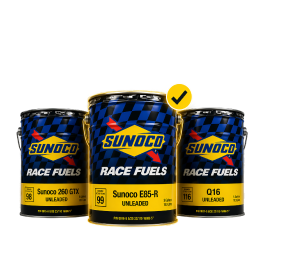
The Sunoco catalog contains several fuels listed specifically for truck and tractor pulling applications, covering a range of octane levels appropriate for different class levels and build intensities.
Sunoco Standard at 110 octane is a practical entry point for modified pulling applications running moderate boost levels. Leaded, ethanol-free, and non-oxygenated, it provides the consistent combustion behavior and detonation resistance that a high-compression gasoline pulling engine needs without introducing the calibration complexity of oxygenated fuels. Its comprehensive additive package supports storage stability between events, which matters for pulling competitors who may not burn through a drum at every show. Standard is listed for truck and tractor pulling in the Sunoco catalog and is available for online ordering and via distributors for programs that want to have fuel secured before arriving at the event.

Sunoco EXO2 is a 110 octane, highly oxygenated leaded fuel with a performance ceiling that exceeds its stated octane rating in real-world applications. The catalog notes that many engines running 112 octane non-oxygenated fuels can successfully run EXO2, which reflects how its oxygenation chemistry interacts with combustion in ways that a simple octane number does not fully capture. In practice, this means moderate-to-high boost applications on built gasoline V8s that have been specifically calibrated for oxygenated fuel. In a pulling application where combustion efficiency directly translates to sustained load performance, the oxygenation advantage is meaningful, provided the fuel system has been calibrated for the additional oxygen content. EXO2 requires tuning adjustments and is best suited to experienced builders running controlled competition environments rather than first-time race fuel users.
Sunoco HCR Plus at 114 octane fills the space between Standard and Maximal for builds that have moved past 110 octane but where the full jump to 116 is unnecessary. Leaded, ethanol-free, and rated for a three-year shelf life, it covers high-compression applications and is listed for nitrous, supercharger, and turbocharger use. For pulling engines where the combination of base compression and boost lands in the 113 to 115 effective octane range, HCR Plus provides a precise match rather than a step that overshoots the requirement.
Sunoco Maximal at 116 octane is where high-boost, high-compression pulling builds land when Standard no longer provides adequate detonation protection. Leaded and ethanol-free with a two-year shelf life, Maximal is listed for truck and tractor pulling in the catalog alongside nitrous, supercharger, and turbocharger applications. Its formulation provides the detonation resistance that extreme cylinder pressure environments demand while maintaining the combustion stability that consistent pull-to-pull performance requires.
Sunoco SR18 at 118 octane represents the top of the gasoline pulling fuel range. Listed for truck and tractor pulling in the catalog, SR18 is built for the unlimited or near-unlimited end of gasoline-powered competition where maximum compression, extreme boost, and fast burn speed are all required simultaneously. Its specific gravity of 0.704 reflects a formulation designed for fast combustion phasing at the high cylinder pressures these builds create. SR18 is the choice when the engine build has exceeded the protection margin of everything below it.
Oxygenated Fuels in Pulling: The Tuning Requirement
Oxygenated race fuels introduce additional oxygen into the combustion process, which supports more complete fuel combustion and can increase power output in a well-tuned engine. In pulling applications where sustained combustion efficiency translates directly into pull length and placement, the argument for oxygenated fuels is real.
The qualification is tuning. A carbureted pulling engine set up for a non-oxygenated fuel runs lean when switched to an oxygenated fuel with the same jetting. Lean conditions under extreme pulling load are precisely the conditions that produce the kind of detonation damage that ends a pull season prematurely. The benefits of oxygenation only materialize when the fuel system has been calibrated to deliver the additional fuel volume the oxygen content requires.
For fuel-injected pulling engines with flexible calibration tools, oxygenated fuels are a more accessible option. For carbureted applications, the transition from non-oxygenated to oxygenated fuel requires deliberate retuning and should be validated on a dyno before competition use. Choosing the right race fuel covers the oxygenated versus non-oxygenated decision in detail, including how oxygen content interacts with carburetor jetting and fuel injection calibration.
Consistency and Specific Gravity in a Single-Run Sport
Pulling is unique among motorsports in its format: one run, one result. There is no opportunity to diagnose a fuel-related tuning issue between laps and make corrections before the result is decided. The fuel in the tank when the hook connects is the fuel the engine is running when the result is posted.
This format makes batch-to-batch fuel consistency more critical in pulling than in almost any other application. An engine tuned precisely for a specific fuel's specific gravity, oxygen content, and vapor pressure needs those parameters to match what is actually in the tank. A fuel that varies in density between fills changes the air-fuel ratio delivered through fixed jets or calibrated injectors. Under the extreme cylinder pressure of a full competition pull, that variation does not produce a slightly off result. It produces either lost performance or lost reliability.
Understanding why specific gravity matters in race fuel is worth the read for any pulling competitor running a carbureted setup, and the same density-to-metering relationship is covered in detail within sprint car fuel applications where carbureted high-load dynamics are equally unforgiving.
Sunoco's Double Distilled process produces fuels to strict batch tolerances specifically to address this variable. A tune built on one drum of Maximal or SR18 carries to the next drum without recalibration. For a pulling competitor where the tune represents hundreds of dyno hours and the result of a single run, that reliability is the foundation of a consistent program.
Vapor Pressure and Heat Management Between Rounds
Vapor pressure is a fuel property that affects pulling applications in a specific way that most other motorsports do not encounter to the same degree. When a pulling vehicle sits in a hot pit area between rounds, the fuel system absorbs ambient heat. A fuel with a vapor pressure that is too high for the ambient temperature can begin to vaporize in the fuel lines or fuel pump, creating vapor pockets that interrupt consistent fuel delivery when the engine comes under load.
This phenomenon is commonly called vapor lock, and it is a reliability concern in any high-heat environment. It is particularly relevant in pulling where the engine goes from sitting in a hot pit to maximum load in a very short time. Purpose-built race fuels are formulated to specific vapor pressure targets that account for operating temperature ranges, removing the guesswork that comes with pump gas whose vapor pressure varies by season and regional formulation.
Where Pulling Programs Come Apart
Running pump gas in a modified high-boost pulling engine is the most direct path to a failed pull and a significant rebuild bill. Pump gas is not formulated for the sustained cylinder pressure environment pulling creates, varies in composition between fills, and provides no guarantee that the calibration built on last month's tank is still accurate on race day.
Underestimating the octane requirement as boost levels increase is equally common. The interaction between base compression ratio, boost pressure, and effective octane demand is not linear. Moving from 20 psi to 30 psi does not require the same octane adjustment as moving from 10 psi to 20 psi. At higher absolute boost levels the octane sensitivity increases, which means conservative estimates of the required octane level become less reliable as the build becomes more aggressive.
Switching fuel types between the tune session and the competition without corresponding tuning adjustments is where programs that were dialed in on the dyno fall apart on the track. A tune optimized for Standard 110 is not accurately calibrated for Maximal 116 without deliberate recalibration. The fuel and the tune are matched, and changing one without adjusting the other is a mechanical risk wearing the appearance of a performance upgrade.
Mixing fuels to approximate an octane level without precisely calculating the resulting specific gravity and oxygen content of the blend introduces a fuel the engine was never actually tuned on. For a pulling engine where the tune was set to specific fuel parameters and the result is determined by a single run, that kind of guesswork carries consequences that show up immediately and expensively.
One Run, One Chance
The fuel decision for a pulling application starts with the class, the engine combination, and the boost and compression levels the build is running. Unlike motorsports where multiple laps or passes allow a team to identify and correct a fuel-related issue, pulling offers no such opportunity. The fuel choice is made in the pits, confirmed at tech, and the result of that decision is posted at the end of a single pass down the track.
That reality makes getting it right the first time the only option worth planning for. Upgrading from pump gas to race fuel is a useful starting point for competitors making that transition for the first time, covering why the move from pump premium to purpose-built race fuel matters beyond octane alone. The Fuel Selector narrows the field based on application and engine parameters, and the Fuel Finder handles local dealer lookup for competitors who want to source fuel close to their event. Standard, Maximal, HCR Plus, and SR18 are all available through Petroleum Service Company for programs that prefer to have fuel on hand well before race day. For builds that require a technical conversation before committing to a fuel, Sunoco's team at 1-800-RACE-GAS is the right starting point.