.svg)


105 Octane Gas: What It Is, Who Needs It, and When Racers Should Use It
INTRODUCTION: WHY FUEL SELECTION MATTERS IN DRAG RACING
In drag racing, power delivery is everything. Whether it's a bracket car, a pro mod, or a modern street car running eighth-mile test-and-tunes, the type of fuel used can make or break a pass. It's not just about octane. Fuel chemistry affects combustion temperature, vaporization speed, and how an engine responds under peak load. When you're chasing hundredths of a second, these factors are anything but minor.
Fuel selection is particularly important because drag racing puts engines under maximum stress for short bursts. Unlike circuit racing, there's no margin to "run it rich" and play it safe over time. You need a fuel that lights up quickly, burns consistently, and doesn't fall off in power run to run. That means understanding the specific needs of your engine setup and matching them to a fuel with the right characteristics.
Consistency is just as critical as performance. Racers want to know that each batch of fuel delivers the same power and behavior as the last. With race-day variables like track temperature and air density already in play, eliminating fuel inconsistency helps isolate the tuning variables that actually matter.
UNDERSTANDING DRAG RACING FUEL REQUIREMENTS
Drag racing engines are built for intense, short-duration performance. That places specific demands on the fuel they consume. Three key properties, octane rating, oxygen content, and evaporation behavior play a major role in how well a fuel performs under these conditions.
Octane rating is essential for preventing detonation in high-compression and forced induction engines. Many drag applications push compression ratios well beyond what standard fuels can tolerate. High-octane race fuels allow tuners to run more aggressive ignition timing and boost levels without risking engine damage. But octane alone isn't the full picture.
Oxygenated fuels introduce more oxygen into the combustion chamber, enabling more fuel to be burned and more power to be made. This is particularly effective in turbocharged or supercharged engines, which already operate at higher intake pressures. The extra oxygen must be paired with tuning adjustments to ensure the air/fuel mixture remains safe and effective.
Evaporation rate, or how quickly a fuel vaporizes, is also crucial in drag racing. Engines that don't fully reach operating temperature before making a pass benefit from fuels that evaporate and ignite more readily at lower temps. Fuels designed with a faster evaporation curve help deliver cleaner combustion and better throttle response right off the line.
Together, these factors help determine how well a fuel matches the demands of a specific engine build. In drag racing, where the window for performance is narrow and unforgiving, getting this match right is fundamental.
DRAG RACING FUELS FOR SPECIALIZED APPLICATIONS: MAXNOS AND CYCLONE 17
Different drag racing setups call for different fuel characteristics, particularly when it comes to high-powered builds and engines that don't fully reach operating temperature before a pass. Two fuels developed for these scenarios - MaxNOS and Cyclone 17, illustrate how targeted fuel design can address specific mechanical needs.
Fuels like MaxNOS are formulated for engines using significant power adders such as nitrous oxide, superchargers, or large turbos. These setups generate extreme combustion pressures and heat, which increase the risk of knock. A fuel designed for this kind of environment will typically include a high octane rating, robust detonation resistance, and controlled burn speed to handle the added stress.
On the other end, some engines in drag racing only run briefly before making a full-power pass. These engines may not fully reach thermal equilibrium, which can make fuel atomization and combustion less efficient. A fuel like Cyclone 17 is designed with a rapid evaporation profile, making it easier to vaporize and ignite at lower engine temperatures. That characteristic improves throttle response and combustion consistency right off the starting line.
In both cases, the fuel is tuned to match a specific engine behavior. Choosing the right one comes down to understanding not just how much power you want to make, but how your engine operates before and during the run.
ETHANOL-BASED FUELS: E30-R AND E85-R IN DRAG RACING
Ethanol-based fuels have become increasingly common in drag racing, especially for modern builds using electronic fuel injection and forced induction. Their appeal lies in the combination of high octane, high oxygen content, and a natural cooling effect during vaporization—all of which support aggressive tuning and improved performance under boost.
E30-R is a dedicated racing fuel that blends 30% ethanol with highly refined hydrocarbons. Unlike pump blends or DIY mixtures, it offers a consistent ethanol percentage from batch to batch, which simplifies tuning and improves reliability. This consistency is especially valuable for late-model performance engines that require precise air/fuel ratios and depend on predictable burn rates under wide-open throttle conditions.
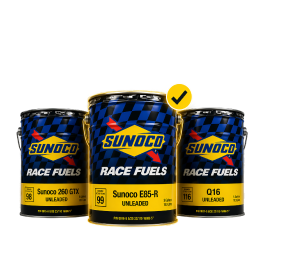
E85-R is another ethanol-rich option, containing a stable 85% ethanol content. Many fuels sold as E85 at the pump can vary widely in actual ethanol percentage depending on the season or region, which complicates tuning. A dedicated race-grade E85 avoids that issue. Its high oxygen content enhances combustion efficiency and allows engines to run cooler, which can be a major advantage in short, high-load events like drag passes. However, the fuel system must be capable of delivering increased volume, as ethanol requires more flow to maintain a proper air/fuel mixture.
Both E30-R and E85-R offer performance advantages, but they also require appropriate fuel system components and tuning strategies. Racers considering ethanol-based fuels need to account for flow demands, sensor compatibility, and the importance of fuel consistency over time. When used properly, these fuels can support excellent power output with improved thermal management.
MATCHING FUEL TO ENGINE TYPE AND TUNING STRATEGY
Choosing the right drag racing fuel is about more than just chasing horsepower. It involves making sure the fuel works with your engine's hardware and your overall tuning approach. Whether you run a naturally aspirated small block or a high-boost turbo setup, fuel compatibility matters at every level.
Leaded fuels are often used in older engines or purpose-built race motors that are not equipped with oxygen sensors or catalytic converters. These fuels provide excellent knock resistance and work well under high cylinder pressures, which is why they are common in extreme builds. However, leaded fuels will damage modern emissions systems and are not suitable for engines that rely on wideband sensors or closed-loop fuel control.
Unleaded fuels are better suited to modern engines, especially those using advanced electronics. They can still offer high octane levels and good combustion characteristics, and they allow for the use of diagnostic and tuning tools that depend on clean exhaust data. Many drag racers with late-model platforms prefer unleaded fuels for this reason.
Oxygenated fuels bring another layer of tuning consideration. The added oxygen helps generate more power by allowing the engine to burn more fuel. To take full advantage of this, the fuel system must deliver a richer mixture. That often means recalibrating injectors, adjusting carburetor jets, or retuning the ECU. Without these adjustments, a highly oxygenated fuel can cause the engine to run too lean.
Fuel selection should align with how the engine is built and how it's tuned. A conservative setup might tolerate more variation, while a high-output combination will need precision. Understanding compression ratio, airflow, ignition timing, and how your tuning software interacts with the fuel will guide the right choice.
FUEL STORAGE, HANDLING, AND SHELF LIFE CONSIDERATIONS FOR DRAG RACERS
In drag racing, fuel performance isn't just about what's in the tank on race day. It's also about how that fuel has been stored and handled. Improper storage can lead to oxidation, vapor loss, or contamination, all of which can compromise consistency and performance.
Most race fuels require storage in tightly sealed, opaque containers to prevent light exposure and air contact. Temperature stability is also important. Keeping fuel away from large swings in heat or cold will help maintain its chemical integrity. Ethanol-based fuels, in particular, are hygroscopic, meaning they absorb moisture from the air. If stored in humid conditions or in partially filled containers, they can degrade more quickly and cause tuning issues.
Fuel drums and pails should be kept sealed when not in use. Avoid using open funnels or siphons that can introduce debris or water into the container. Any vented storage should include vapor recovery systems or proper caps to minimize air exchange. Even fuels with strong antioxidant packages will start to degrade if exposed to air over time.
Shelf life varies depending on the formulation. Non-oxygenated race fuels tend to last longer than oxygenated blends. Ethanol-heavy fuels generally have a shorter storage window unless they are specifically stabilized. Checking fuel freshness by verifying specific gravity or visual clarity can help spot problems before they affect performance.
Handling race fuel safely also means using proper protective gear. Gloves, safety glasses, and well-ventilated workspaces are standard practice. Fuel spills should be cleaned immediately, and empty containers should be stored securely until they can be properly disposed of or refilled.
Consistent fuel behavior starts long before it reaches the tank. Proper storage and handling protect your investment and help ensure the fuel performs exactly as expected when it matters most.
SUNOCO'S PROVEN LEGACY IN DRAG RACING
In the world of drag racing, reputation isn't given; it's earned over time, track by track, and pass by pass. Sunoco has spent more than five decades supplying fuels to racers across all forms of motorsports, building trust through consistency, quality, and deep involvement in the racing community. That legacy is one reason many racers continue to choose Sunoco when performance and reliability matter most.
Sunoco fuels are engineered with a focus on repeatability. Each batch is tested and certified to meet exacting standards, ensuring that what goes into the tank on race day performs the same as it did the last time. This consistency matters in drag racing, where even minor variations in fuel composition can affect tuning, throttle response, and elapsed times. Sunoco's proprietary double distillation process is one of the ways it ensures that level of quality and predictability.
Beyond the fuel itself, Sunoco supports racers with technical expertise and resources that help teams get the most from their setup. Whether it's understanding how to optimize an oxygenated blend or selecting the best fuel for a specific engine combination, Sunoco's race fuel helpline and technical team are available to provide guidance rooted in real racing experience.
This long-standing commitment to motorsports isn't just about product development. It's about being present in the lanes, in the pits, and behind the scenes working with racers to deliver the fuel performance needed to compete at every level.
CONCLUSION: FUEL SELECTION AS A KEY TO DRAG RACING PERFORMANCE
In drag racing, where engines operate at the edge of their limits during short bursts of extreme output, fuel is a critical part of the performance equation. It influences how much power an engine can make, how reliably it runs, and how easily it can be tuned for specific track and weather conditions.
The right fuel supports your engine's compression, induction, and combustion requirements. Whether you're working with a high-boost turbo setup, a nitrous-assisted build, or a naturally aspirated engine tuned for maximum efficiency, selecting a fuel that matches those demands is essential. Fuel characteristics like octane rating, oxygen content, and evaporation rate all play a role in how effectively the engine performs.
Consistency across batches and clear technical information also make a difference. Fuels that behave the same from run to run help reduce tuning guesswork and improve reliability. When a racer knows exactly how a fuel will perform, they can focus on dialing in other parts of the setup with greater precision.
In a sport where small changes can have big effects, making an informed fuel choice gives you one more advantage. It's not just about the numbers on the label, it's about how the fuel works with your engine, your tune, and your goals on race day. For more information on selecting the right racing fuel for your drag racing application, visit Sunoco Race Fuels or use our fuel selector tool to find the perfect match for your setup.