.svg)


Which Race Fuels Work Best for Powersports
Snowmobiles push fuel harder than most people realize. Between sustained high RPM, sub-zero temperatures, and the way riders actually ride, wide open across a frozen lake, climbing a mountain trail, or staging at a drag event on a groomed track, sled engines place demands on fuel that pump gas was never designed to meet. The consequences of getting it wrong are real. Detonation, melted ring lands, and destroyed pistons are not edge cases. They are what happens when the fuel cannot keep pace with the engine's compression, timing, and heat load.
The right fuel is not always the most expensive one. Understanding what your engine actually needs is what separates a smart fuel choice from an expensive one that changes nothing.
Higher Octane Fuel Does Not Automatically Mean More Power
This is worth saying clearly before anything else because it is one of the most persistent misunderstandings in the snowmobile community. Octane measures a fuel's resistance to detonation, not its energy content. As Snow Goer explains, running a higher-octane fuel in an engine calibrated for 87 or 91 octane will not improve power or make the sled run better. The engine has no mechanism to take advantage of the additional knock resistance, so nothing changes except what you spent at the pump.
Race fuel earns its place when the engine has been modified past the point where pump gas can safely support the tune. Raised compression, ignition timing advance beyond the factory map, forced induction, or an aftermarket ECU calibrated around a specific fuel are all situations where pump premium becomes inadequate. At that point choosing the right fuel is not an upgrade, it is a requirement.
For stock trail sleds, the OEM recommendation of 91 octane premium remains the right call. Ethanol-free pump fuel is worth seeking out where available, particularly for sleds that sit between rides, since ethanol-blended fuels absorb moisture over time and introduce fuel system problems that compound during storage.

The Five Fuels That Cover the Full Range of Snowmobile Builds
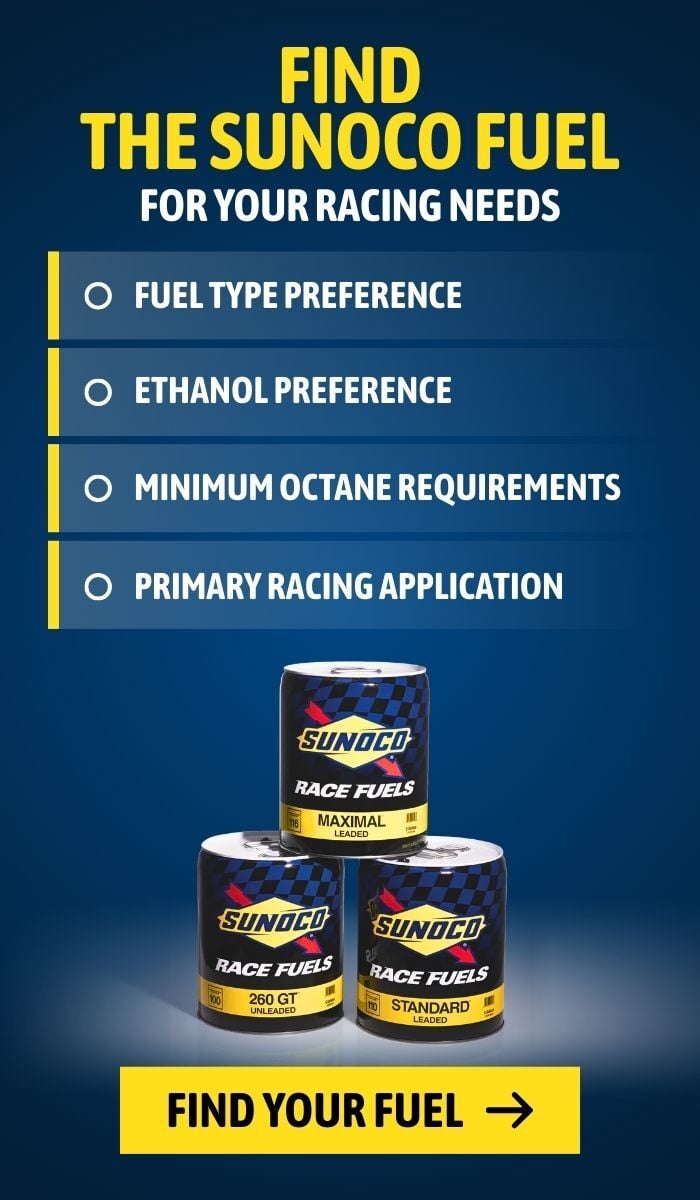
There are five Sunoco fuels that address the practical range of snowmobile applications from stock trail sleds to dedicated race engines. Each one occupies a distinct role, and the differences between them are meaningful enough that fuel selection becomes straightforward once you understand what your engine actually needs.
Sunoco Optima is a 95 octane, ethanol-free, unleaded fuel with a shelf life exceeding three years. A large part of its value for snowmobile riders is about what it does not contain; with no ethanol, it cannot absorb moisture during storage, will not cause phase separation in a tank sitting from April through November, and will not degrade carburetor passages or injector components the way ethanol-blended pump fuel does over months of sitting. It is formulated to mix cleanly with 2-stroke oils in both air-cooled and water-cooled applications, and it does not require additional fuel stabilizers. Optima and Surge (detailed below) are both approved for ISOC and CSRA snowcross racing by the Polaris, Arctic Cat, and Ski-Doo race departments, which reflects how deliberately these fuels were developed for the snowmobile environment.
Sunoco Surge is a 105 octane, leaded, non-ethanol fuel blended specifically for high-RPM engines in snowmobiles, dirt bikes, ATVs, and side-by-sides. What sets Surge apart for sled applications is its cold-weather behavior. It is formulated for easy cold starting and quick throttle response in carbureted applications, which is a real and measurable advantage when starting a sled at 10 degrees. It is blended from highly refined hydrocarbons to ensure year-round consistency, carries a three-year shelf life, and is dyed light yellow to prevent confusion when mixing 2-stroke oil. For riders who buy fuel at the start of the season and want that stock to remain viable deep into the riding calendar, Surge is one of the most practical choices on this list.
Sunoco 260 GT is a 100 octane unleaded fuel with 10.0% ethanol and the natural next step for modified sleds that have outgrown pump premium but are not yet running compression or boost levels that demand 110 or higher. It is explicitly compatible with 2-stroke synthetic and mineral-based engine oils, will not harm oxygen sensors or catalytic converters, and carries an additive package designed to minimize engine and fuel system deposits. For lightly modified sleds running raised compression pistons, mild timing changes, or a ported cylinder that still uses OEM fueling components, 260 GT delivers race-quality consistency at an octane level the engine can actually use.
Sunoco Standard is 110 octane, leaded, and ethanol-free with a shelf life exceeding two years. It is non-oxygenated, which makes its behavior highly predictable across tuning setups without introducing ethanol-related calibration variables into a precision fuel map. Standard covers the territory where most seriously modified snowmobiles operate: high-compression naturally aspirated builds, mid-range turbo applications running meaningful boost, and sleds where significant timing advance is baked into the tune. Its additive package improves storage stability and minimizes oxidation, which matters for sleds that are not burning through a drum every weekend.
Sunoco Supreme is 112 octane, leaded, and ethanol-free, and it is the fuel most commonly found in competitive snowmobile racing. The octane handles maximum compression builds, but what makes Supreme specifically relevant for high-RPM sled applications is its fast burn speed. Supreme is designed for engines operating above 7,000 RPM, and that specification maps directly onto snowmobile applications. Pipe-tuned 2-strokes operate within very narrow power bands where combustion timing windows are tight. A fuel that burns too slowly will not fully release its energy before the exhaust port opens, which costs power and generates heat. Supreme's burn characteristics are tuned for exactly that environment.
2-Stroke Sleds vs. Turbo Sleds: Different Engines, Different Fuel Priorities
This distinction matters because 2-stroke and turbocharged 4-stroke snowmobiles have fundamentally different reasons for needing race fuel, and that changes which fuel characteristics matter most for each.
In a 2-stroke engine, heat accumulates faster, the margin between a clean combustion event and a destructive one is thinner, and the exhaust pipe creates a very specific pressure wave that the engine relies on to extract maximum power in a narrow RPM window. For pipe-tuned 2-strokes, burn speed is as important as octane. A fuel that burns too slowly misses that window entirely, leaving power on the table and raising cylinder temperatures in the process. This is why Supreme at 112 octane is the dominant choice for competitive 2-stroke sled builds. Its fast burn speed aligns with the combustion timing demands of a high-RPM ported engine in a way that a slower-burning fuel at the same octane level simply cannot replicate. 260 GT is the appropriate step up for lightly modified 2-strokes that still run OEM fueling but have moved past what pump premium safely supports.
Turbocharged 4-stroke snowmobiles have a different challenge. Boost pressure multiplies cylinder pressure in a way that changes the fuel requirement dynamically as boost increases. Every additional pound of boost effectively raises the compression ratio the fuel must handle, which means the right octane for a turbo sled is not a fixed number — it moves with the tune. As a practical starting point, mild boost applications in the 8 to 12 psi range are often well served by 260 GT at 100 octane on conservative tunes. Builds running 12 to 18 psi need the additional knock resistance that Standard at 110 provides, and Standard's non-oxygenated, ethanol-free formulation makes it a stable and predictable foundation for turbo tune maps. Above 18 psi, Supreme at 112 becomes the appropriate choice, where both octane and combustion stability under extreme pressure matter equally. For the highest-output turbo competition builds, the Fuel Selector is the most reliable way to confirm the right product for a specific combination.
One thing both engine types share is that an inconsistent fuel introduces risk no tune can fully account for. A 2-stroke running a pipe-tuned map needs the same burn speed from every fill. A turbo sled dialed in on a specific fuel map needs the same specific gravity, oxygen content, and volatility from drum to drum. This is what makes the source of the fuel matter as much as the octane number on the label.
What Cold Weather Does to Fuel That Most Guides Never Address
Almost all race fuel content is written with summer motorsports in mind. Snowmobiles operate in conditions that change the fuel equation in ways worth understanding, and this is one of the few places where snowmobile-specific fuel guidance genuinely differs from general race fuel advice.
Volatility is the key variable. For fuel to support clean cold starts and consistent combustion well below freezing, it needs to vaporize adequately in a cold intake and combustion chamber. A fuel with insufficient cold-weather volatility produces hard starts, inconsistent combustion, and sluggish response until the engine warms. For high-compression builds where cold cranking already demands more from the fuel system, this is not a minor inconvenience.
Pump gas accounts for this with seasonal reformulation. Winter blends carry different volatility profiles than summer blends, which means the pump gas your sled runs in December is a meaningfully different product than what was in the pump in August. Race fuel produced to consistent year-round specifications does not shift seasonally, so its cold-weather behavior is a deliberate product characteristic rather than a seasonal variable. Surge is specifically noted for easy cold starting and quick throttle response in carbureted applications, and its RVP of 8.0 psi reflects a volatility profile well suited to cold-weather sled applications. Understanding how Reid Vapor Pressure affects cold-start performance, storage stability, and fuel consistency is one of the more useful things a performance-minded rider can learn about how fuels actually behave in cold conditions.
Temperature swings between rides also affect stored fuel. A tank cycling between a cold garage and a warm day on the trail creates condensation risk, particularly with ethanol-blended fuels sitting in a partially filled tank. Keeping ethanol out of the equation where possible reduces that risk, which is another reason non-ethanol options like Surge, Standard, and Supreme hold up better between events than ethanol-containing alternatives.

Why Consistency Matters as Much as the Octane Number
A tuner calibrating a fuel and ignition map is not just dialing in for an octane number. They are building a map around a specific fuel's oxygen content, specific gravity, burn speed, and volatility. As Sunoco's technical breakdown of specific gravity points out, a lower specific gravity generally indicates a faster-burning fuel — and switching between fuels of different specific gravity without accounting for it means the tune is no longer accurately matched, even if the octane rating is identical.
For a snowmobile engine running at high RPM in cold conditions on a fixed tune, that kind of hidden variability is genuinely dangerous. A 110 octane fuel with tight batch tolerances is something a builder can map around with confidence. One that drifts in specific gravity, oxygen content, or volatility between batches introduces a variable the tune was never built to handle.
Sunoco's Double Distilled process produces every fuel to strict batch tolerances at the Marcus Hook facility, which is why serious engine builders specify by manufacturer rather than octane number alone. A tune built on one drum of Supreme or Standard should transfer to the next without adjustment. For a competition sled where the map is dialed close to the edge of safe operation, that reliability is not a convenience, it is a safety margin.
Storing Fuel Between Rides and Through the Off-Season
A sled sitting from April through November with a partial tank of untreated pump fuel is a reliable path to a frustrating first ride of the following season. Gummed carb passages, phase-separated ethanol, and degraded injector seals are all avoidable with the right storage habits from the start, and the cost of prevention is a fraction of what a fuel system overhaul runs at the beginning of a season.
The container matters more than most riders give it credit for. Sealed, non-vented metal or approved HDPE containers stored away from temperature swings and UV exposure are the baseline. Airspace is the enemy of stored fuel, the more oxygen sitting above the fuel line, the faster oxidation degrades the blend and strips away the lighter hydrocarbons that keep octane intact. Label every container with the fuel type and the date it was filled. That habit alone prevents the guesswork that leads to running year-old oxygenated fuel in a freshly tuned engine.
Non-oxygenated fuels stored properly hold for two years or more without meaningful degradation. Ethanol-containing fuels are a different story. Ethanol is hygroscopic, meaning it actively pulls moisture from the surrounding air. In a partially filled tank with temperature cycling between a cold garage and warmer days, that moisture absorption accelerates. Once enough water accumulates, the ethanol and water separate from the gasoline entirely and sink to the bottom of the tank as a distinct layer. That layer does not combust cleanly, and it is corrosive to fuel system components that were not designed to handle it. Running the engine briefly at the start of each season to circulate fresh fuel through the system before putting the sled under load is a simple habit that catches these issues before they become mechanical ones.
For sleds going into extended off-season storage, Sunoco Optima is the purpose-built answer. Its three-year shelf life removes the guesswork from seasonal storage entirely, and its ethanol-free formulation means moisture absorption and phase separation are not part of the equation. Optima is specifically formulated to protect gaskets, o-rings, and other fuel system components that ethanol degrades over time, and it mixes cleanly with 2-stroke oils in both air-cooled and water-cooled applications without requiring a separate stabilizer. A sled put away on Optima in the spring is a sled that starts cleanly in November without the carburetor rebuild that a summer of degraded ethanol pump fuel tends to require. The Sunoco race fuel storage page covers storage science and best practices in more depth for riders who want to understand the chemistry behind why these habits matter.
Choosing the Right Fuel For Your Sled
A stock trail sled, a ported 2-stroke race engine, and a high-boost turbo sled do not share a fuel recommendation, and that is the point. Fuel selection is not a single answer applied across all builds. Start with an honest read on the build: compression ratio, boost level, ignition map, engine type, and whether the tune was calibrated around a specific fuel. Those inputs point to an octane level, and from there the right product becomes clear.
Getting fuel is straightforward once you know what you need. The Fuel Finder locates authorized dealers near you, and several Sunoco fuels are available to order online. For builds that sit outside the standard guidelines or where a technical conversation would help before committing to a fuel, Sunoco's team is reachable at 1-800-RACE-GAS and can work through the specifics of your combination directly.
If you ride other powersports equipment alongside your sled, the same fuel principles that apply here carry over to motocross bikes, ATVs, and UTVs. Engine type, compression, boost, and tune are the variables that drive fuel selection across all of them, and the Sunoco powersports fuel guide covers those applications in the same depth this guide covers snowmobiles.
Fuel is one of the few parts of a performance build where getting it right costs no more than getting it wrong. The difference is just knowing what the engine needs before you fill the tank.